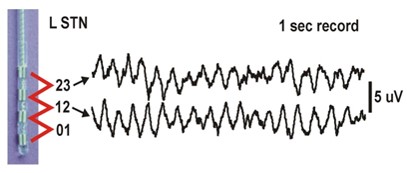
Emerging technologies for improved deep brain stimulation.


Here, we review how advances in the understanding of neural circuit function, together with advances in technology, are opening up deep brain stimulation as a treatment for a wide range of disorders. Central to the future application of this therapy will be means of promoting selectivity of action, by controlling precisely when stimulation is applied and where it effects.
Scientific Abstract
Deep brain stimulation (DBS) is an effective treatment for common movement disorders and has been used to modulate neural activity through delivery of electrical stimulation to key brain structures. The long-term efficacy of stimulation in treating disorders, such as Parkinson's disease and essential tremor, has encouraged its application to a wide range of neurological and psychiatric conditions. Nevertheless, adoption of DBS remains limited, even in Parkinson's disease. Recent failed clinical trials of DBS in major depression, and modest treatment outcomes in dementia and epilepsy, are spurring further development. These improvements focus on interaction with disease circuits through complementary, spatially and temporally specific approaches. Spatial specificity is promoted by the use of segmented electrodes and field steering, and temporal specificity involves the delivery of patterned stimulation, mostly controlled through disease-related feedback. Underpinning these developments are new insights into brain structure-function relationships and aberrant circuit dynamics, including new methods with which to assess and refine the clinical effects of stimulation.
Similar content
Modulation of motor cortical theta and gamma oscillations using phase-targeted, closed-loop optogenetic stimulation of local excitatory and inhibitory neurons.
A clinical grade neurostimulation implant for hierarchical control of physiological activity
Influence of time of day on resting motor threshold in clinical TMS practice
Cortical signatures of sleep are altered following effective deep brain stimulation for depression
Emerging technologies for improved deep brain stimulation.
Here, we review how advances in the understanding of neural circuit function, together with advances in technology, are opening up deep brain stimulation as a treatment for a wide range of disorders. Central to the future application of this therapy will be means of promoting selectivity of action, by controlling precisely when stimulation is applied and where it effects.
Scientific Abstract
Deep brain stimulation (DBS) is an effective treatment for common movement disorders and has been used to modulate neural activity through delivery of electrical stimulation to key brain structures. The long-term efficacy of stimulation in treating disorders, such as Parkinson's disease and essential tremor, has encouraged its application to a wide range of neurological and psychiatric conditions. Nevertheless, adoption of DBS remains limited, even in Parkinson's disease. Recent failed clinical trials of DBS in major depression, and modest treatment outcomes in dementia and epilepsy, are spurring further development. These improvements focus on interaction with disease circuits through complementary, spatially and temporally specific approaches. Spatial specificity is promoted by the use of segmented electrodes and field steering, and temporal specificity involves the delivery of patterned stimulation, mostly controlled through disease-related feedback. Underpinning these developments are new insights into brain structure-function relationships and aberrant circuit dynamics, including new methods with which to assess and refine the clinical effects of stimulation.
Citation
Free Full Text at Europe PMC
PMC6877347Downloads