Subthalamic nucleus local field potential activity helps encode motor effort rather than force in parkinsonism.


The basal ganglia are involved in motor control and their function deranged in conditions like Parkinson's disease. Scientists have tended to believe that the basal ganglia, and the subthalamic nucleus in particular, help select the appropriate force with which a voluntary movement is made. Here we show that activity in the subthalamic nucleus codes the effort made rather than the force exerted.
Scientific Abstract
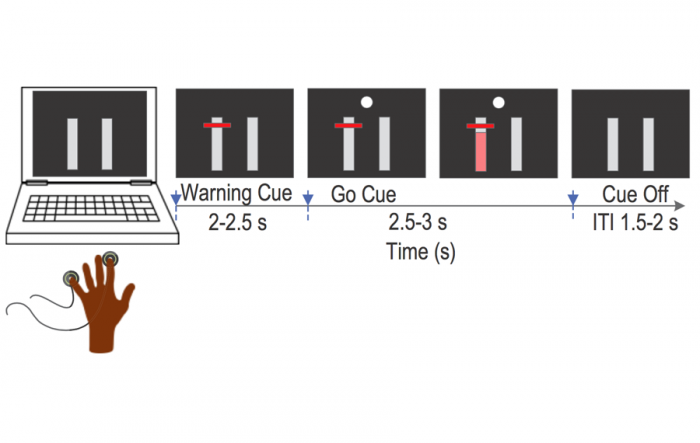
Local field potential (LFP) recordings from patients with deep brain stimulation electrodes in the basal ganglia have suggested that frequency-specific activities correlate with force or effort, but previous studies have not been able to disambiguate the two. Here, we dissociated effort from actual force generated by contrasting the force generation of different fingers while recording LFP activity from the subthalamic nucleus (STN) in patients with Parkinson's disease who had undergone functional surgery. Patients were studied while on their normal dopaminergic medication. We investigated the relationship between frequency-specific oscillatory activity in the STN and voluntary flexion of either the index or little finger at different effort levels. At each tested effort level (10%, 25%, and 40% of the maximal voluntary contraction force of each individual finger), the index finger generated larger force than the little finger. Movement-related suppression of beta-band power in the STN LFP was significantly modulated by effort, but not by which finger was used, suggesting that the beta suppression in the STN LFP during sustained contraction serves as a proxy for effort. The absolute force scaled with beta power suppression, but with the scaling determined by the maximal voluntary contraction force of the motor effector. Our results argue against the hypothesis that the basal ganglia are directly involved in the parameterization of force during movement and support a role of the STN in the control of motor effort to be attributed to a response.
Similar content
Dithering suppresses half-harmonic neural synchronisation to photic stimulation in humans.
Frequency-specific and spatiotemporal dynamics of β-γ phase-amplitude coupling in Parkinson's disease.
Characterising motor and cognitive contributions of cortical beta oscillations and their modulation with rTMS.
Flexible and Stable Cycle-by-Cycle Phase-Locked Deep Brain Stimulation System Targeting Brain Oscillations in the Management of Movement Disorders
Subthalamic nucleus local field potential activity helps encode motor effort rather than force in parkinsonism.
The basal ganglia are involved in motor control and their function deranged in conditions like Parkinson's disease. Scientists have tended to believe that the basal ganglia, and the subthalamic nucleus in particular, help select the appropriate force with which a voluntary movement is made. Here we show that activity in the subthalamic nucleus codes the effort made rather than the force exerted.
Scientific Abstract
Local field potential (LFP) recordings from patients with deep brain stimulation electrodes in the basal ganglia have suggested that frequency-specific activities correlate with force or effort, but previous studies have not been able to disambiguate the two. Here, we dissociated effort from actual force generated by contrasting the force generation of different fingers while recording LFP activity from the subthalamic nucleus (STN) in patients with Parkinson's disease who had undergone functional surgery. Patients were studied while on their normal dopaminergic medication. We investigated the relationship between frequency-specific oscillatory activity in the STN and voluntary flexion of either the index or little finger at different effort levels. At each tested effort level (10%, 25%, and 40% of the maximal voluntary contraction force of each individual finger), the index finger generated larger force than the little finger. Movement-related suppression of beta-band power in the STN LFP was significantly modulated by effort, but not by which finger was used, suggesting that the beta suppression in the STN LFP during sustained contraction serves as a proxy for effort. The absolute force scaled with beta power suppression, but with the scaling determined by the maximal voluntary contraction force of the motor effector. Our results argue against the hypothesis that the basal ganglia are directly involved in the parameterization of force during movement and support a role of the STN in the control of motor effort to be attributed to a response.
Citation
Free Full Text at Europe PMC
PMC4397595Downloads