Dithering suppresses half-harmonic neural synchronisation to photic stimulation in humans.







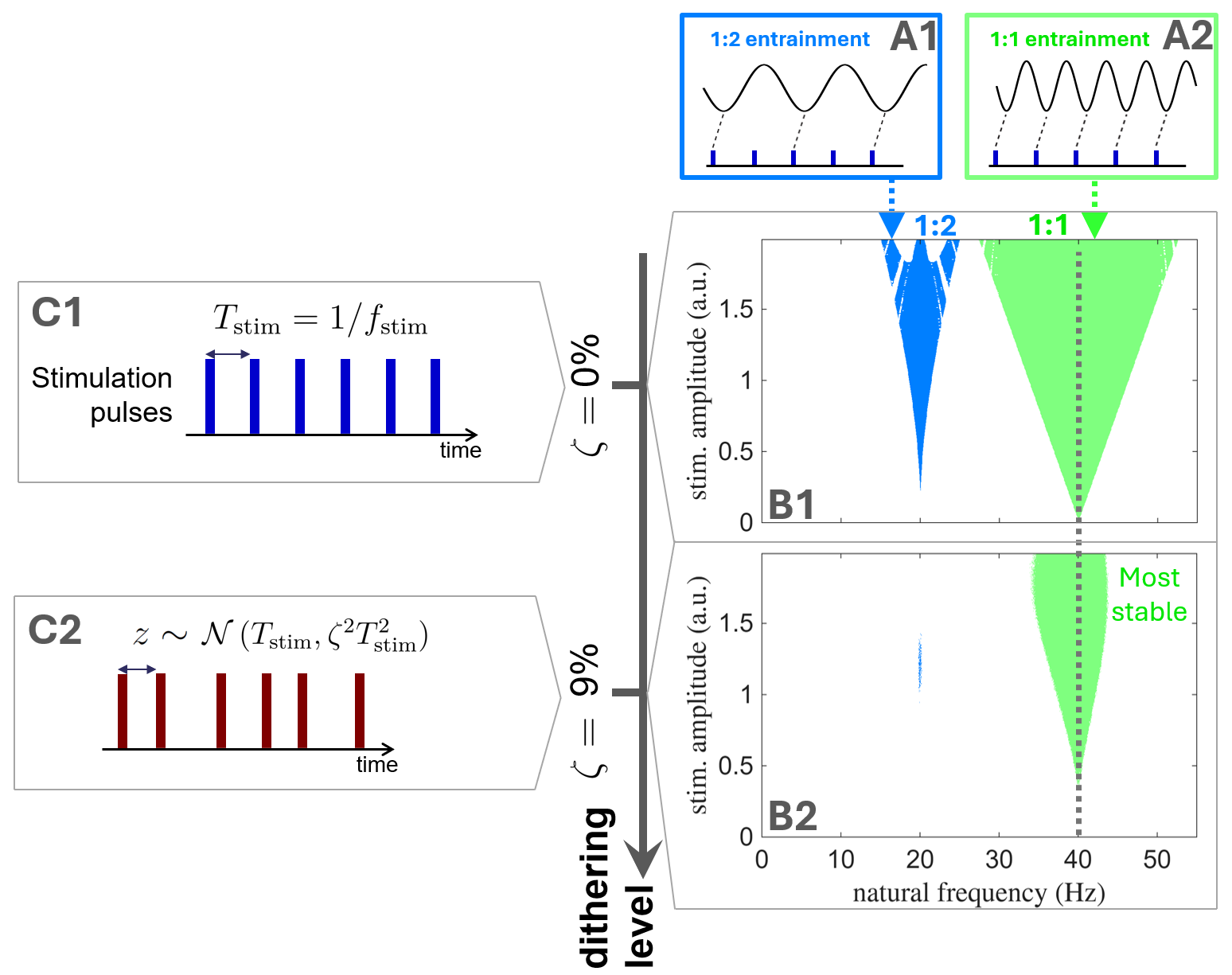
Brain stimulation can guide brain rhythms, but perfectly regular pulses can also make off-target brain rhythms lock onto the stimulation. This study used flickering light and brainwave recording in healthy participants to test “dithering”, which consists in adding small timing jitters to the flashes. Dithering reduced unwanted brain synchronisation, suggesting a simple way to make future stimulation treatments more selective, and potentially safer, by avoiding off-target rhythms.
Scientific Abstract
Similar content
ePC: Fast and Deep Predictive Coding in Digital Simulation
ePC: Fast and Deep Predictive Coding in Digital Simulation
On the Infinite Width and Depth Limits of Predictive Coding Networks
Temporally distinct reward and action prediction error signals during value learning and habit formation
Citation
DOI
Free Full Text at Europe PMC
PMC13328066Downloads
Dithering suppresses half-harmonic neural synchronisation to photic stimulation in humans.
Brain stimulation can guide brain rhythms, but perfectly regular pulses can also make off-target brain rhythms lock onto the stimulation. This study used flickering light and brainwave recording in healthy participants to test “dithering”, which consists in adding small timing jitters to the flashes. Dithering reduced unwanted brain synchronisation, suggesting a simple way to make future stimulation treatments more selective, and potentially safer, by avoiding off-target rhythms.
Scientific Abstract
Citation
DOI
Free Full Text at Europe PMC
PMC13328066Downloads