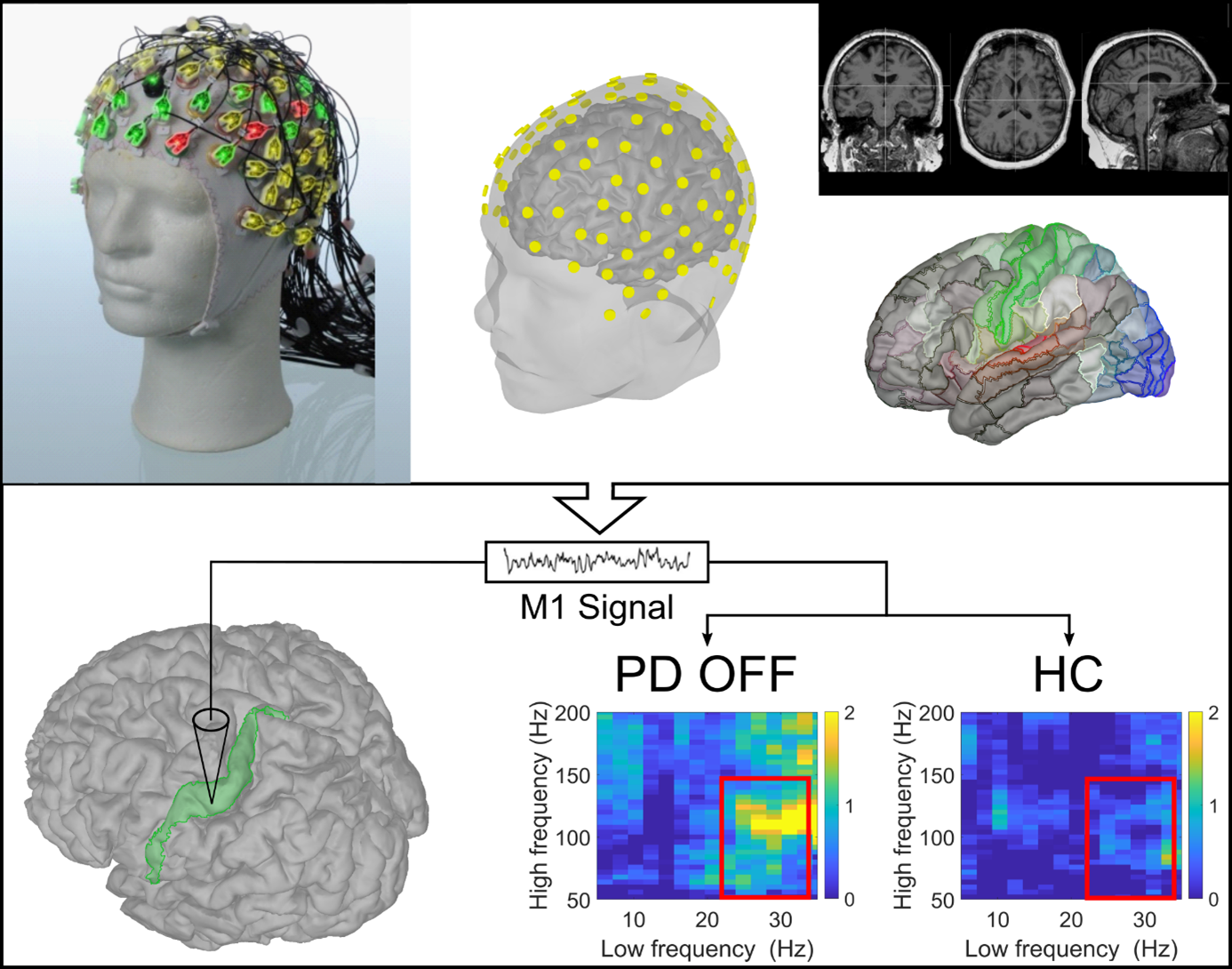
Frequency-specific and spatiotemporal dynamics of β-γ phase-amplitude coupling in Parkinson's disease.

Parkinson's disease disrupts brain rhythms, causing abnormal communication within the motor network that impairs movement. We found a specific pattern of brain rhythms that was abnormally elevated in Parkinson’s and correlated with slowness and stiffness – but not tremor. Medication reduced this pattern, and the reduction was linked to clinical improvement, suggesting it as a non-invasive biomarker and promising target for personalised brain stimulation.
Scientific Abstract
Cross-frequency coupling (CFC) has been proposed to facilitate neural information transfer across spatial and temporal scales. Phase-amplitude coupling (PAC), a type of CFC in which the amplitude of a faster brain oscillation is coupled to the phase of a slower brain oscillation, is implicated in various higher-order cognitive functions and was shown to be pathologically altered in neurological and psychiatric disease. In Parkinson's disease (PD), the coupling between gamma amplitude (50-150 Hz) and beta phase (13-35 Hz) is exaggerated. Enhanced β-γ PAC was found in the subthalamic nucleus and various cortical sources and shown to be responsive to dopaminergic therapy and deep brain stimulation (DBS). Therefore, exaggerated β-γ PAC has been proposed to be a disease marker and a potential target for brain circuit interventions. Despite these promising findings, a significant knowledge gap remains, as the spatial and frequency-specific dynamics of β-γ PAC and its association with motor symptoms and therapy remain elusive. To address this knowledge gap, we employed high-density electroencephalography (EEG) with source localisation techniques for patients with PD at rest. We highlight three key findings: (1) a frequency-specific increase in high β (23-35 Hz)-γ PAC within and between sources of the cortical motor network, (2) a link between elevated high β-γ PAC and bradykinesia and rigidity when OFF medication, but not tremor, and (3) a medication-induced reduction in high β-γ PAC in the supplementary motor area correlating with clinical improvement. Altogether, this study provides novel insights into the pathophysiology of PD as an oscillopathy and identifies high β-γ PAC as a potential marker of Parkinsonian symptoms and treatment effects. This has important implications for invasive as well as non-invasive therapeutic strategies as high β-γ PAC targeting might hold greater promise than targeting β-γ PAC per se.
Similar content
Characterising motor and cognitive contributions of cortical beta oscillations and their modulation with rTMS.
Flexible and Stable Cycle-by-Cycle Phase-Locked Deep Brain Stimulation System Targeting Brain Oscillations in the Management of Movement Disorders
Driving theta-gamma oscillations modulates extrasynaptic GABAergic tone: a tACS-TMS study
Dithering suppresses half-harmonic neural synchronisation to photic stimulation in humans
Frequency-specific and spatiotemporal dynamics of β-γ phase-amplitude coupling in Parkinson's disease.

Parkinson's disease disrupts brain rhythms, causing abnormal communication within the motor network that impairs movement. We found a specific pattern of brain rhythms that was abnormally elevated in Parkinson’s and correlated with slowness and stiffness – but not tremor. Medication reduced this pattern, and the reduction was linked to clinical improvement, suggesting it as a non-invasive biomarker and promising target for personalised brain stimulation.
Scientific Abstract
Cross-frequency coupling (CFC) has been proposed to facilitate neural information transfer across spatial and temporal scales. Phase-amplitude coupling (PAC), a type of CFC in which the amplitude of a faster brain oscillation is coupled to the phase of a slower brain oscillation, is implicated in various higher-order cognitive functions and was shown to be pathologically altered in neurological and psychiatric disease. In Parkinson's disease (PD), the coupling between gamma amplitude (50-150 Hz) and beta phase (13-35 Hz) is exaggerated. Enhanced β-γ PAC was found in the subthalamic nucleus and various cortical sources and shown to be responsive to dopaminergic therapy and deep brain stimulation (DBS). Therefore, exaggerated β-γ PAC has been proposed to be a disease marker and a potential target for brain circuit interventions. Despite these promising findings, a significant knowledge gap remains, as the spatial and frequency-specific dynamics of β-γ PAC and its association with motor symptoms and therapy remain elusive. To address this knowledge gap, we employed high-density electroencephalography (EEG) with source localisation techniques for patients with PD at rest. We highlight three key findings: (1) a frequency-specific increase in high β (23-35 Hz)-γ PAC within and between sources of the cortical motor network, (2) a link between elevated high β-γ PAC and bradykinesia and rigidity when OFF medication, but not tremor, and (3) a medication-induced reduction in high β-γ PAC in the supplementary motor area correlating with clinical improvement. Altogether, this study provides novel insights into the pathophysiology of PD as an oscillopathy and identifies high β-γ PAC as a potential marker of Parkinsonian symptoms and treatment effects. This has important implications for invasive as well as non-invasive therapeutic strategies as high β-γ PAC targeting might hold greater promise than targeting β-γ PAC per se.
Citation
DOI
Downloads