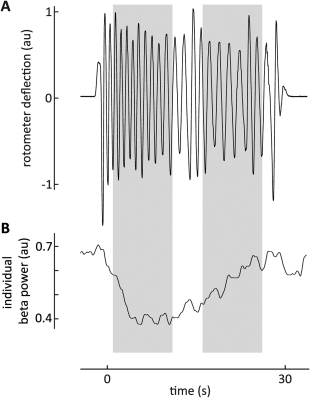
Subthalamic beta dynamics mirror Parkinsonian bradykinesia months after neurostimulator implantation.


If brain signals are to be used to control when and how brain stimulation is applied for therapy, then we must be confident that such signals remain consistent and informative over time. Using a special brain pacemaker device that allowed us to record brain signals over long periods, we show that these signals remain informative about the clinical states of people with Parkinson’s for many months.
Scientific Abstract
Exaggerated oscillatory activity in the beta frequency band in the subthalamic nucleus has been suggested to be related to bradykinesia in Parkinson's disease (PD). However, studies seeking correlations between such activity in the local field potential and motor performance have been limited to the immediate postoperative period, which may be confounded by a stun effect that leads to the temporary alleviation of PD deficits.
Similar content
Paper
MRC CoRE in RND Output
Dithering suppresses half-harmonic neural synchronisation to photic stimulation in humans.
2026. Brain Stimul, 19(3):103111.
Free Full Text at Europe PMC
PMC13328066
Paper
Frequency-specific and spatiotemporal dynamics of β-γ phase-amplitude coupling in Parkinson's disease.
2026. Brain (e-Pub ahead of print).
Paper
MRC CoRE in RND Output
Characterising motor and cognitive contributions of cortical beta oscillations and their modulation with rTMS.
2026. Neuroimage, 331:121893.
Preprint
Flexible and Stable Cycle-by-Cycle Phase-Locked Deep Brain Stimulation System Targeting Brain Oscillations in the Management of Movement Disorders
Subthalamic beta dynamics mirror Parkinsonian bradykinesia months after neurostimulator implantation.
If brain signals are to be used to control when and how brain stimulation is applied for therapy, then we must be confident that such signals remain consistent and informative over time. Using a special brain pacemaker device that allowed us to record brain signals over long periods, we show that these signals remain informative about the clinical states of people with Parkinson’s for many months.
Scientific Abstract
Exaggerated oscillatory activity in the beta frequency band in the subthalamic nucleus has been suggested to be related to bradykinesia in Parkinson's disease (PD). However, studies seeking correlations between such activity in the local field potential and motor performance have been limited to the immediate postoperative period, which may be confounded by a stun effect that leads to the temporary alleviation of PD deficits.
Citation
2017.Mov. Disord., 32(8):1183-1190.
Free Full Text at Europe PMC
PMC5575541Downloads
Similar content
Paper
MRC CoRE in RND Output
Dithering suppresses half-harmonic neural synchronisation to photic stimulation in humans.
2026. Brain Stimul, 19(3):103111.
Free Full Text at Europe PMC
PMC13328066
Paper
Frequency-specific and spatiotemporal dynamics of β-γ phase-amplitude coupling in Parkinson's disease.
2026. Brain (e-Pub ahead of print).
Paper
MRC CoRE in RND Output
Characterising motor and cognitive contributions of cortical beta oscillations and their modulation with rTMS.
2026. Neuroimage, 331:121893.
Preprint