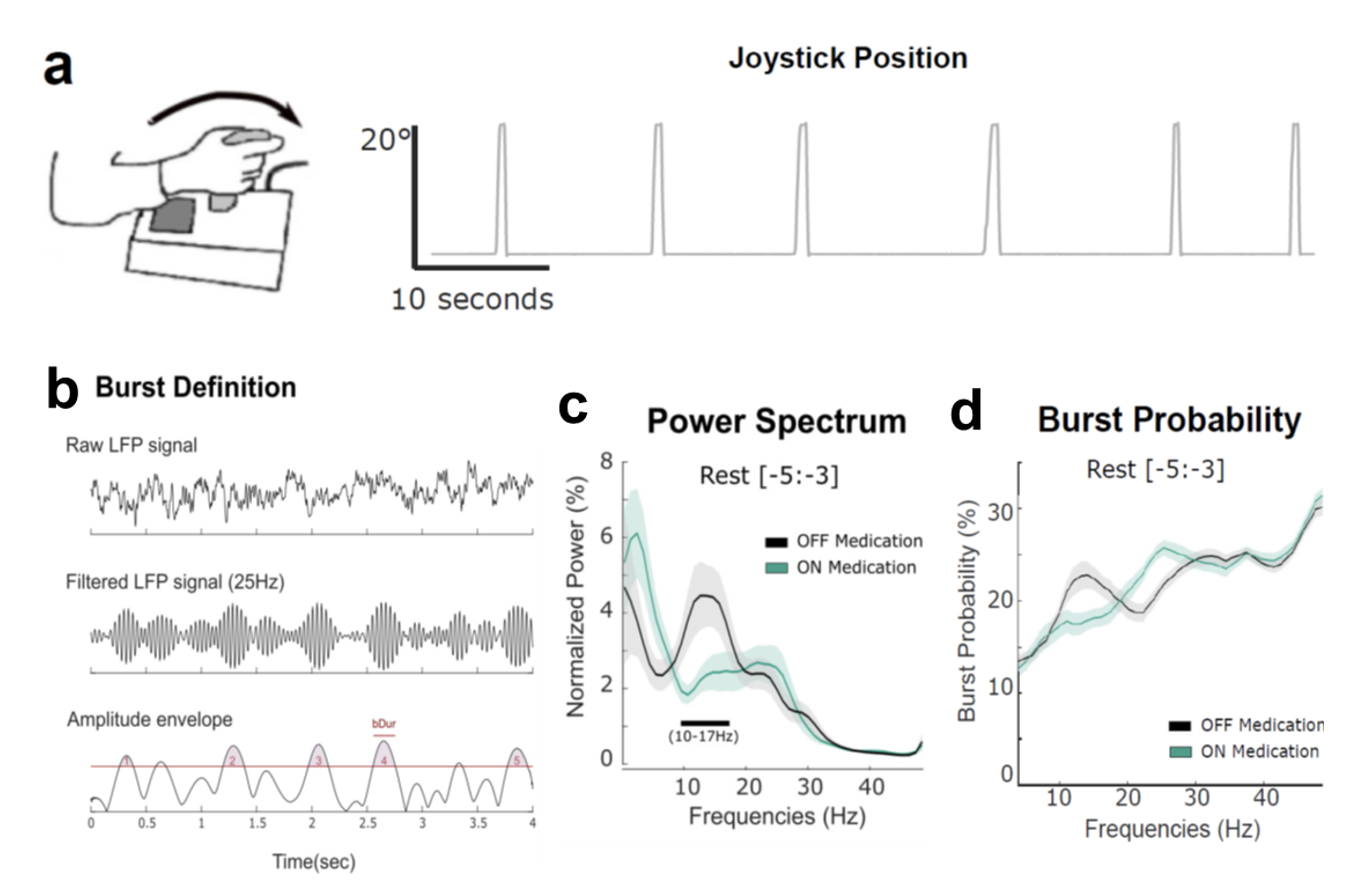
Average power and burst analysis revealed complementary information on drug-related changes of motor performance in Parkinson's disease.

Brain activity in the form of brain waves has been analysed so far by either calculating the average intensity in time, or by measuring characteristics of bursts (short bouts of brain activity). Here, we compared the two methods and show that they can offer complementary information on how activities in deep brain nuclei are modulated by movements, and how the modulation is affected by Parkinson’s and dopaminergic medication.
Scientific Abstract
Similar content
Dithering suppresses half-harmonic neural synchronisation to photic stimulation in humans.
Frequency-specific and spatiotemporal dynamics of β-γ phase-amplitude coupling in Parkinson's disease.
Characterising motor and cognitive contributions of cortical beta oscillations and their modulation with rTMS.
Flexible and Stable Cycle-by-Cycle Phase-Locked Deep Brain Stimulation System Targeting Brain Oscillations in the Management of Movement Disorders
Citation
DOI
Free Full Text at Europe PMC
PMC10275865Downloads
Average power and burst analysis revealed complementary information on drug-related changes of motor performance in Parkinson's disease.
Brain activity in the form of brain waves has been analysed so far by either calculating the average intensity in time, or by measuring characteristics of bursts (short bouts of brain activity). Here, we compared the two methods and show that they can offer complementary information on how activities in deep brain nuclei are modulated by movements, and how the modulation is affected by Parkinson’s and dopaminergic medication.
Scientific Abstract
Citation
DOI
Free Full Text at Europe PMC
PMC10275865Downloads