Adaptive deep brain stimulation for Parkinson's disease demonstrates reduced speech side effects compared to conventional stimulation in the acute setting.


We have shown that ‘deep brain stimulation’ for the treatment of Parkinson’s disease can be made more efficient if it is triggered by abnormal brain signals. Here, we show that the speech impairments that can follow the stimulation procedure can be reduced when such triggering is introduced, without reducing the overall effectiveness of the treatment for relieving other movement difficulties.
Scientific Abstract
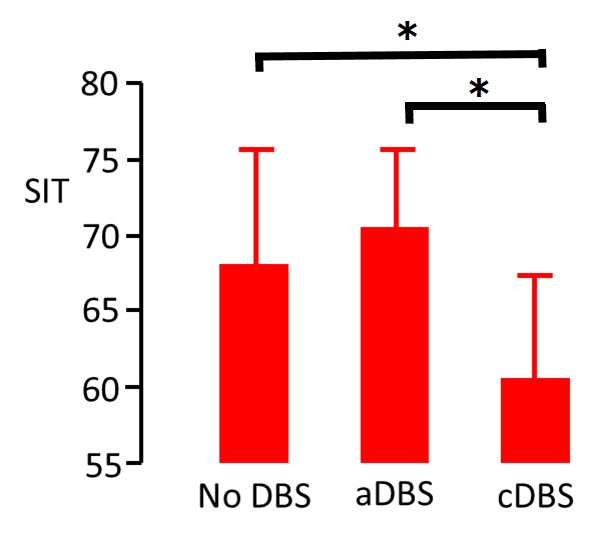
Objective: Adaptive deep brain stimulation (aDBS) appears at least as effective in treating motor impairment as conventional stimulation (cDBS) in Parkinson’s disease. Here we investigate whether aDBS can also increase the therapeutic window of stimulation and thereby decrease speech side-effects compared to conventional stimulation (cDBS) in Parkinson’s disease. Methods: We tested 8 subjects 3-6 days after surgery using a blinded standardised speech intelligibility test (SIT) under aDBS, cDBS and off stimulation conditions in the acute setting. Motor scores were also assessed in 6 of the 8 subjects using blinded video recordings. Results: With electrical parameters of stimulation optimised to aDBS, speech intelligibility was significantly better (SIT score 70.4 ± 6.4 %) compared to parameter-matched cDBS (60.5 ± 8.2 %, p=0.02) with motor function also enhanced (p=0.04). Interpretation: At equal stimulation parameters, acute aDBS does not compromise speech intelligibility whilst being superior to cDBS for motor efficacy in the acute setting.
Similar content
Phase-targeted modulation of essential tremor with transcranial magnetic stimulation of motor cortex
Thalamocortical dynamics underlying spontaneous transitions in beta power in Parkinsonism
Tuning the brakes – Modulatory role of transcranial random noise stimulation on inhibition
Cortico-thalamic tremor circuits and their associations with deep brain stimulation effects in essential tremor
Citation
Free Full Text at Europe PMC
PMC5136720Downloads
Adaptive deep brain stimulation for Parkinson's disease demonstrates reduced speech side effects compared to conventional stimulation in the acute setting.
We have shown that ‘deep brain stimulation’ for the treatment of Parkinson’s disease can be made more efficient if it is triggered by abnormal brain signals. Here, we show that the speech impairments that can follow the stimulation procedure can be reduced when such triggering is introduced, without reducing the overall effectiveness of the treatment for relieving other movement difficulties.
Scientific Abstract
Objective: Adaptive deep brain stimulation (aDBS) appears at least as effective in treating motor impairment as conventional stimulation (cDBS) in Parkinson’s disease. Here we investigate whether aDBS can also increase the therapeutic window of stimulation and thereby decrease speech side-effects compared to conventional stimulation (cDBS) in Parkinson’s disease. Methods: We tested 8 subjects 3-6 days after surgery using a blinded standardised speech intelligibility test (SIT) under aDBS, cDBS and off stimulation conditions in the acute setting. Motor scores were also assessed in 6 of the 8 subjects using blinded video recordings. Results: With electrical parameters of stimulation optimised to aDBS, speech intelligibility was significantly better (SIT score 70.4 ± 6.4 %) compared to parameter-matched cDBS (60.5 ± 8.2 %, p=0.02) with motor function also enhanced (p=0.04). Interpretation: At equal stimulation parameters, acute aDBS does not compromise speech intelligibility whilst being superior to cDBS for motor efficacy in the acute setting.
Citation
Free Full Text at Europe PMC
PMC5136720Downloads