Beta-triggered adaptive deep brain stimulation during reaching movement in Parkinson's disease.





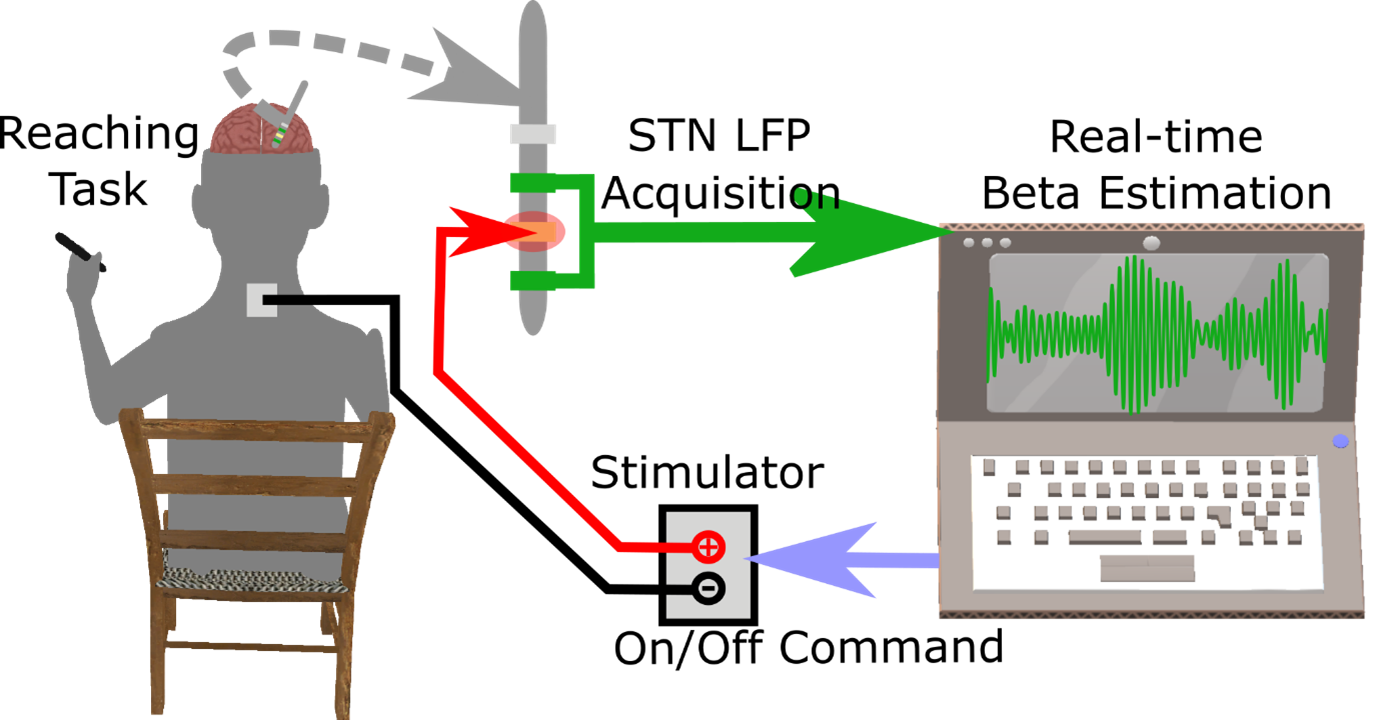
In people with Parkinson’s disease, we compared adaptive deep brain stimulation (DBS) to continuous DBS. The adaptive DBS was triggered by brain wave activity at frequencies called ‘beta’, detected in the subthalamic nucleus region. The two types of DBS were equally effective at improving reaching arm movements, while adaptive DBS was less disruptive of higher-frequency waves, called 'gamma', occurring during these movements.
Scientific Abstract
Similar content
A clinical grade neurostimulation implant for hierarchical control of physiological activity
Diurnal modulation of subthalamic beta oscillatory power in Parkinson’s disease patients during deep brain stimulation
Influence of time of day on resting motor threshold in clinical TMS practice
Cortical signatures of sleep are altered following effective deep brain stimulation for depression
Citation
DOI
Free Full Text at Europe PMC
PMC10690014Downloads
Beta-triggered adaptive deep brain stimulation during reaching movement in Parkinson's disease.
In people with Parkinson’s disease, we compared adaptive deep brain stimulation (DBS) to continuous DBS. The adaptive DBS was triggered by brain wave activity at frequencies called ‘beta’, detected in the subthalamic nucleus region. The two types of DBS were equally effective at improving reaching arm movements, while adaptive DBS was less disruptive of higher-frequency waves, called 'gamma', occurring during these movements.
Scientific Abstract
Citation
DOI
Free Full Text at Europe PMC
PMC10690014Downloads