Increasing human motor skill acquisition by driving theta-gamma coupling.

Akkad H
Dupont-Hadwen J
Kane E
Evans C
Barrett L
Frese A
Tetkovic I
Bestmann S

Learning new motor skills, such as how to play the piano, is important for every-day life. However, little is known about the brain changes that support this learning. Here, we show that driving specific patterns of brain activity in the primary motor area of the brain increases learning in healthy adults. This finding helps us understand more about learning across the brain, and to develop new treatments to help recovery after brain injuries.

Scientific Abstract

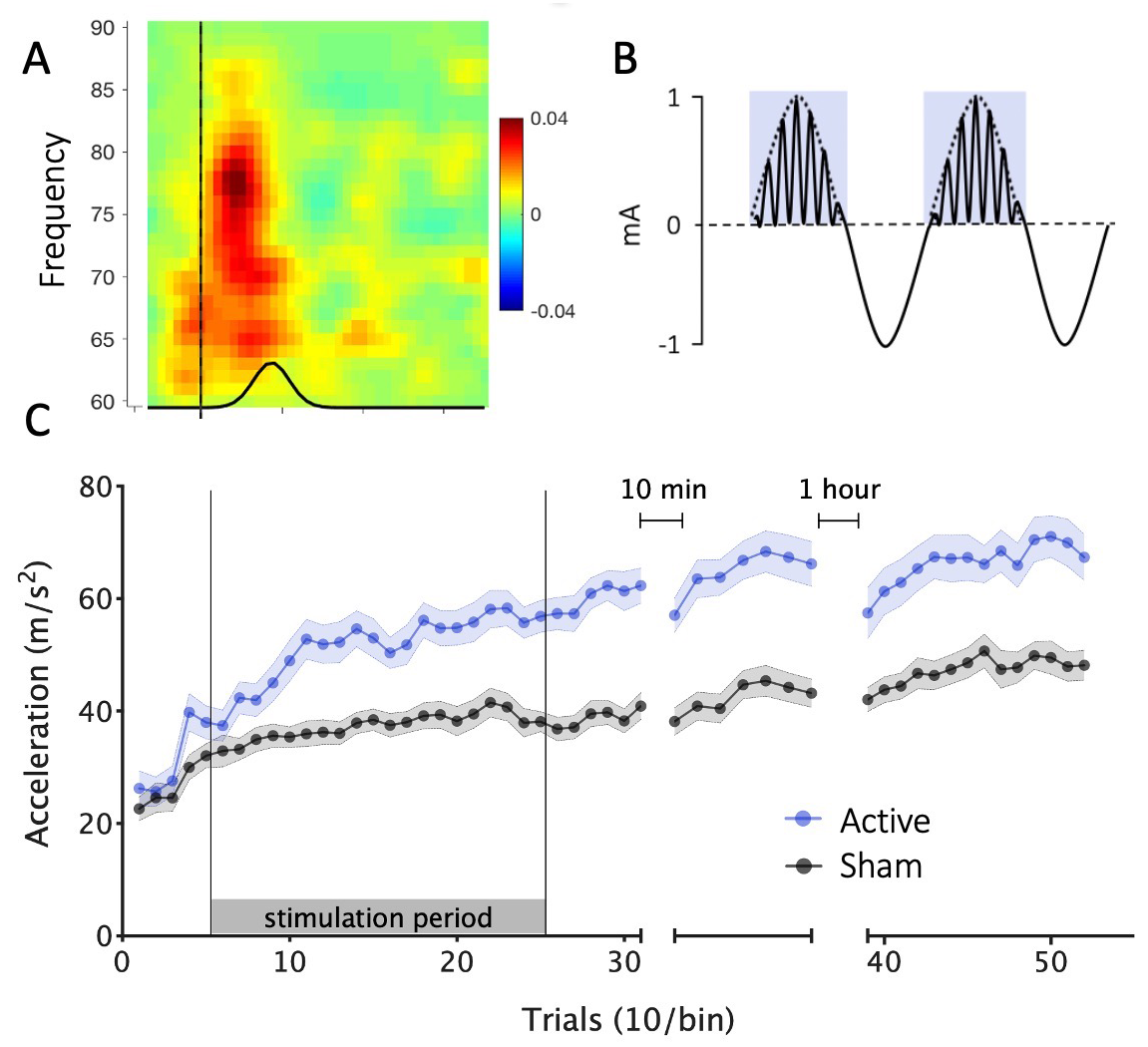
Skill learning is a fundamental adaptive process, but the mechanisms remain poorly understood. Some learning paradigms, particularly in the memory domain, are closely associated with gamma activity that is amplitude modulated by the phase of underlying theta activity, but whether such nested activity patterns also underpin skill learning is unknown. Here, we addressed this question by using transcranial alternating current stimulation (tACS) over sensorimotor cortex to modulate theta-gamma activity during motor skill acquisition, as an exemplar of a non-hippocampal-dependent task. We demonstrated, and then replicated, a significant improvement in skill acquisition with theta-gamma tACS, which outlasted the stimulation by an hour. Our results suggest that theta-gamma activity may be a common mechanism for learning across the brain and provides a putative novel intervention for optimizing functional improvements in response to training or therapy.

Similar content

Preprint
Gann MA, Paparella IA, Zich C, Grigoras IF, Huertas-Penen S, Rieger SW, Thielscher A, Sharott A, Stagg CJ, Schwab BC

Dual-site beta transcranial alternating current stimulation during a bimanual coordination task modulates functional connectivity between motor areas
Increasing human motor skill acquisition by driving theta-gamma coupling.

Akkad H
Dupont-Hadwen J
Kane E
Evans C
Barrett L
Frese A
Tetkovic I
Bestmann S

Learning new motor skills, such as how to play the piano, is important for every-day life. However, little is known about the brain changes that support this learning. Here, we show that driving specific patterns of brain activity in the primary motor area of the brain increases learning in healthy adults. This finding helps us understand more about learning across the brain, and to develop new treatments to help recovery after brain injuries.

Scientific Abstract

Skill learning is a fundamental adaptive process, but the mechanisms remain poorly understood. Some learning paradigms, particularly in the memory domain, are closely associated with gamma activity that is amplitude modulated by the phase of underlying theta activity, but whether such nested activity patterns also underpin skill learning is unknown. Here, we addressed this question by using transcranial alternating current stimulation (tACS) over sensorimotor cortex to modulate theta-gamma activity during motor skill acquisition, as an exemplar of a non-hippocampal-dependent task. We demonstrated, and then replicated, a significant improvement in skill acquisition with theta-gamma tACS, which outlasted the stimulation by an hour. Our results suggest that theta-gamma activity may be a common mechanism for learning across the brain and provides a putative novel intervention for optimizing functional improvements in response to training or therapy.

Citation

2021. eLife, 10:e67355

DOI

10.7554/eLife.67355

Free Full Text at Europe PMC

PMC8687660

Downloads

View PDF (2MB)

Similar content

Preprint
Gann MA, Paparella IA, Zich C, Grigoras IF, Huertas-Penen S, Rieger SW, Thielscher A, Sharott A, Stagg CJ, Schwab BC

Dual-site beta transcranial alternating current stimulation during a bimanual coordination task modulates functional connectivity between motor areas