A learning-evoked slow-oscillatory architecture paces population activity for offline reactivation across the human medial temporal lobe





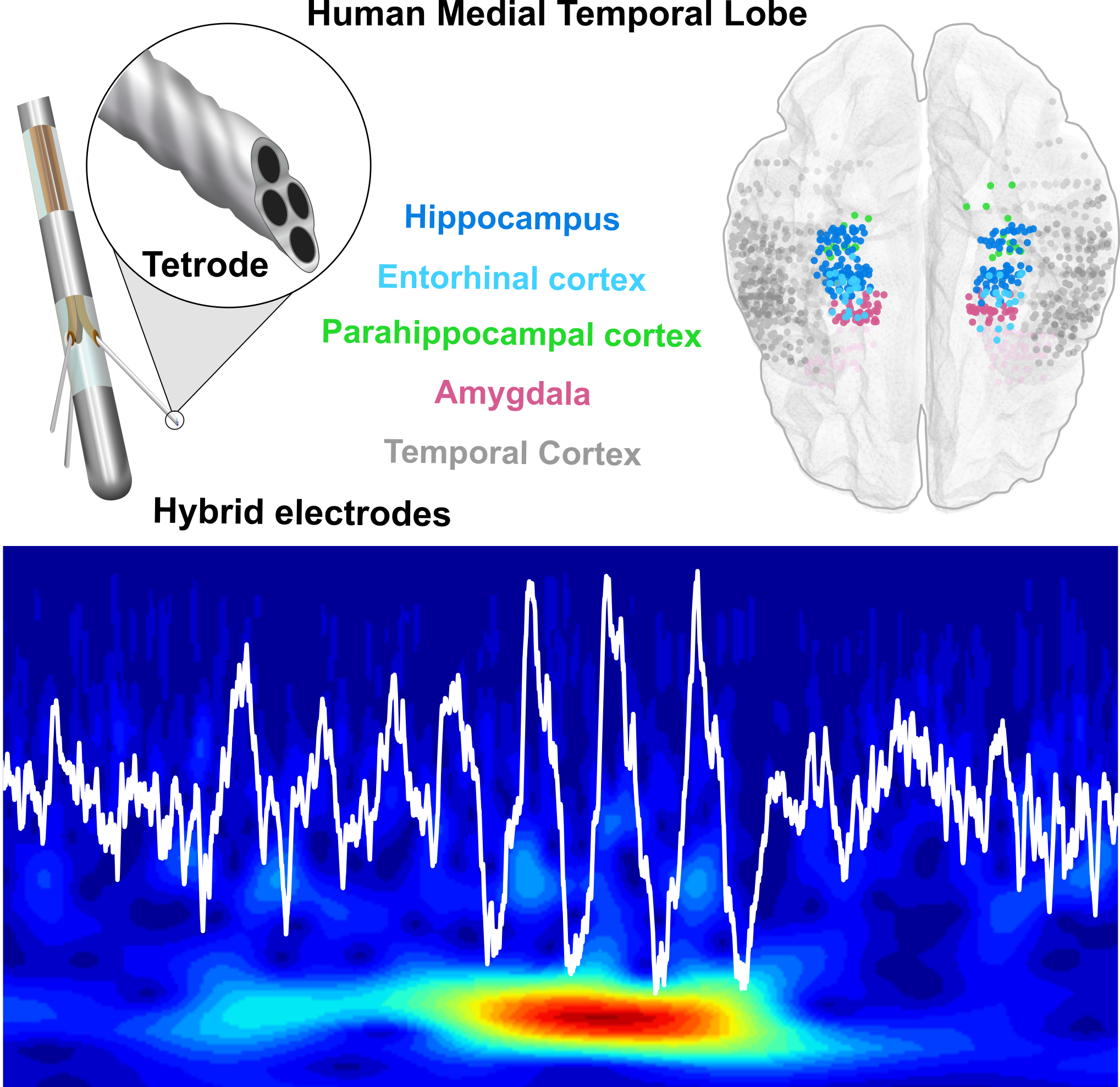
How does the human brain turn new experiences into memories? Causse et al. found that memory processing evokes transient, slow-oscillatory bursts in the human hippocampus. These bursts coordinate neuronal populations across the medial temporal lobe during learning, organizing patterns of activity that are reactivated during hippocampal ripples at rest. The stronger the reactivation, the better memories were recalled later, revealing a mechanism that links learning, memory consolidation, and recall in the human brain.
Scientific Abstract
Memory processing requires coordinated engagement of neuronal populations across brain networks and over time. How such coordination is organized in the human medial temporal lobe (MTL) remains unclear. Here, we show that MTL population activity is dynamically structured by a transient slow-oscillatory architecture that emerges during learning to promote offline consolidation and later recall. Using intracranial recordings that combine single-neuron spiking activity and local field potentials in human participants, we find that mnemonic engagement elicits on-demand slow-oscillatory bursts in the hippocampus. These hippocampal bursts synchronize gamma-band patterns across MTL regions, defining discrete coordination events that pace cross-regional coactivity motifs during learning. These learning-evoked population motifs are selectively reactivated during hippocampal ripples in post-learning rest, and the strength of their reactivation predicts subsequent recall accuracy. Together, these findings identify a multi-scale coordination mechanism that links distributed population activity across learning, consolidation, and recall in humans.
Similar content
How does curriculum learning influence cognitive map formation?
Noradrenaline causes a spread of association in the hippocampal cognitive map
Citation
DOI
Downloads
A learning-evoked slow-oscillatory architecture paces population activity for offline reactivation across the human medial temporal lobe
How does the human brain turn new experiences into memories? Causse et al. found that memory processing evokes transient, slow-oscillatory bursts in the human hippocampus. These bursts coordinate neuronal populations across the medial temporal lobe during learning, organizing patterns of activity that are reactivated during hippocampal ripples at rest. The stronger the reactivation, the better memories were recalled later, revealing a mechanism that links learning, memory consolidation, and recall in the human brain.
Scientific Abstract
Memory processing requires coordinated engagement of neuronal populations across brain networks and over time. How such coordination is organized in the human medial temporal lobe (MTL) remains unclear. Here, we show that MTL population activity is dynamically structured by a transient slow-oscillatory architecture that emerges during learning to promote offline consolidation and later recall. Using intracranial recordings that combine single-neuron spiking activity and local field potentials in human participants, we find that mnemonic engagement elicits on-demand slow-oscillatory bursts in the hippocampus. These hippocampal bursts synchronize gamma-band patterns across MTL regions, defining discrete coordination events that pace cross-regional coactivity motifs during learning. These learning-evoked population motifs are selectively reactivated during hippocampal ripples in post-learning rest, and the strength of their reactivation predicts subsequent recall accuracy. Together, these findings identify a multi-scale coordination mechanism that links distributed population activity across learning, consolidation, and recall in humans.
Citation
DOI
Downloads