The hippocampus as a generative model.





S. Nalluru and L. Glitz contributed equally to this work.
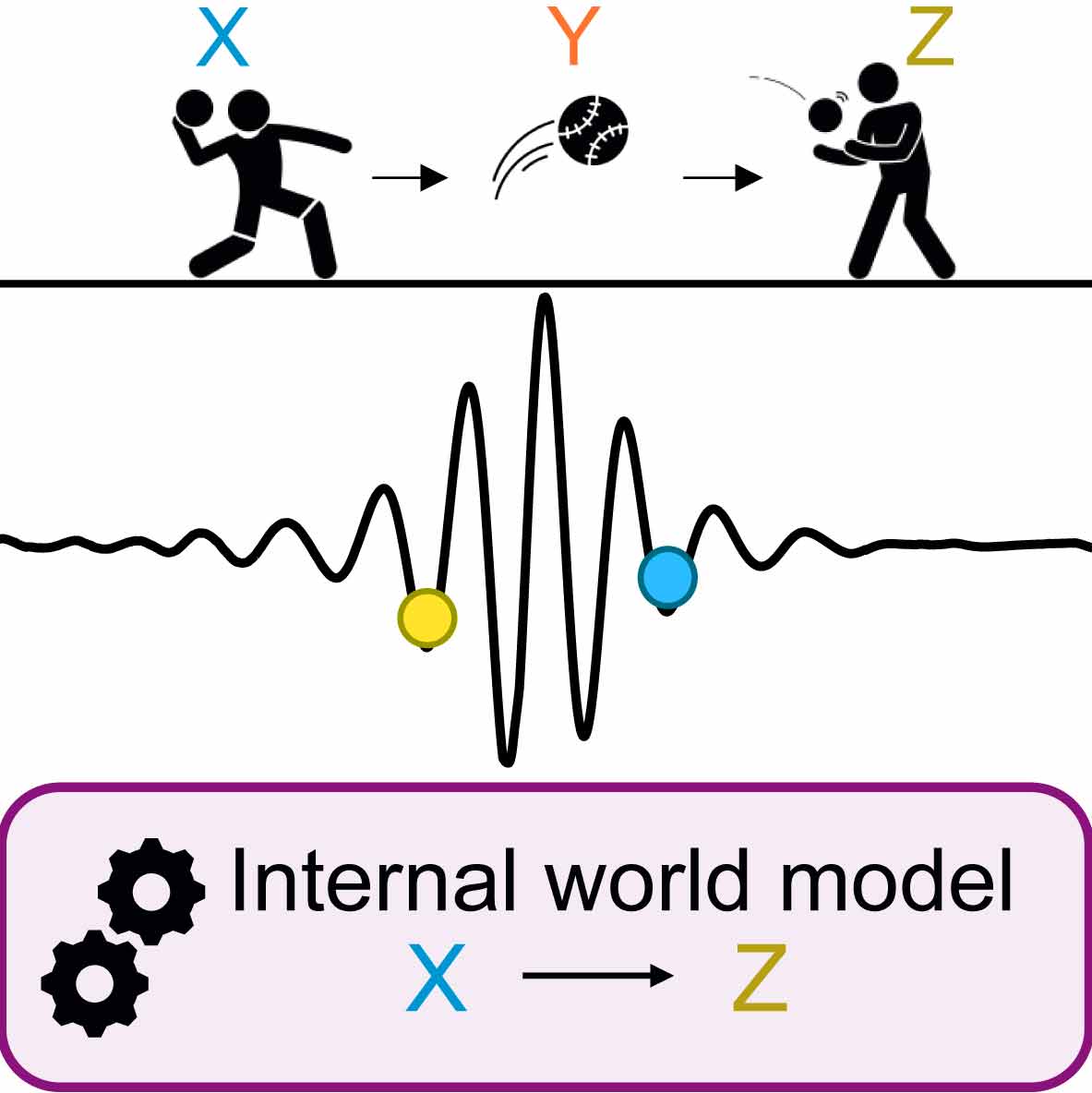
In this perspective we propose that the hippocampus functions as a “generative model”. The hippocampus is a brain region important for memory that is thought to represent a cognitive map of the environment. We extend this view to suggest the hippocampus can both represent the unobserved causes of sensory input and use these representations to generate novel internal representations that support prediction and planning. We also explore how distrubances to the hippocampal generative model may account for core symptoms observed in neuropsychiatric disorders, such as psychosis.
Scientific Abstract
A generative model can be defined as a model of the latent causes of sensory input that can be used to generate new data samples. By examining empirical evidence and computational theory, we propose that the hippocampus can be characterized as a generative model. The hippocampus is a brain region important for memory. Recordings of neural activity from the hippocampus have led to the view that the hippocampus represents a cognitive map by abstracting a low-dimensional representation of the external world. We extend this view to suggest the hippocampus represents the latent, unobserved causes of sensory data by virtue of the position of the hippocampus within the deep cortical hierarchy. These representations of unobserved latent causes endow the hippocampus with capacity to generate new data samples that allow exploration of future hypotheticals and provide an internally generated training signal back to the generative model. We explore how perturbations to the hippocampal generative model may explain core symptoms of neuropsychiatric disorders such as those observed in psychosis. Together, this perspective provides a unified account of hippocampal function that explains how computations performed by the hippocampus support higher-order cognition and adaptive behaviour. This article is part of the theme issue 'The role of hippocampal predictions in cognition: bridging perception and memory'.
Similar content
A learning-evoked slow-oscillatory architecture paces population activity for offline reactivation across the human medial temporal lobe
How does curriculum learning influence cognitive map formation?
Noradrenaline causes a spread of association in the hippocampal cognitive map
Citation
DOI
Downloads
The hippocampus as a generative model.
S. Nalluru and L. Glitz contributed equally to this work.
In this perspective we propose that the hippocampus functions as a “generative model”. The hippocampus is a brain region important for memory that is thought to represent a cognitive map of the environment. We extend this view to suggest the hippocampus can both represent the unobserved causes of sensory input and use these representations to generate novel internal representations that support prediction and planning. We also explore how distrubances to the hippocampal generative model may account for core symptoms observed in neuropsychiatric disorders, such as psychosis.
Scientific Abstract
A generative model can be defined as a model of the latent causes of sensory input that can be used to generate new data samples. By examining empirical evidence and computational theory, we propose that the hippocampus can be characterized as a generative model. The hippocampus is a brain region important for memory. Recordings of neural activity from the hippocampus have led to the view that the hippocampus represents a cognitive map by abstracting a low-dimensional representation of the external world. We extend this view to suggest the hippocampus represents the latent, unobserved causes of sensory data by virtue of the position of the hippocampus within the deep cortical hierarchy. These representations of unobserved latent causes endow the hippocampus with capacity to generate new data samples that allow exploration of future hypotheticals and provide an internally generated training signal back to the generative model. We explore how perturbations to the hippocampal generative model may explain core symptoms of neuropsychiatric disorders such as those observed in psychosis. Together, this perspective provides a unified account of hippocampal function that explains how computations performed by the hippocampus support higher-order cognition and adaptive behaviour. This article is part of the theme issue 'The role of hippocampal predictions in cognition: bridging perception and memory'.
Citation
DOI
Downloads