Tremor Asymmetry and the Development of Bilateral Phase-Specific Deep Brain Stimulation for Postural Tremor.



Postural tremor is a common symptom in movement disorders. This study shows that postural tremors are often uneven, with one hand exhibiting stronger and more stable tremor. Deep brain stimulation (DBS) can help reduce this imbalance. A new DBS approach that matches tremor timing (‘phase’) in each hand separately may be more effective than standard DBS for relieving postural tremor.
Scientific Abstract
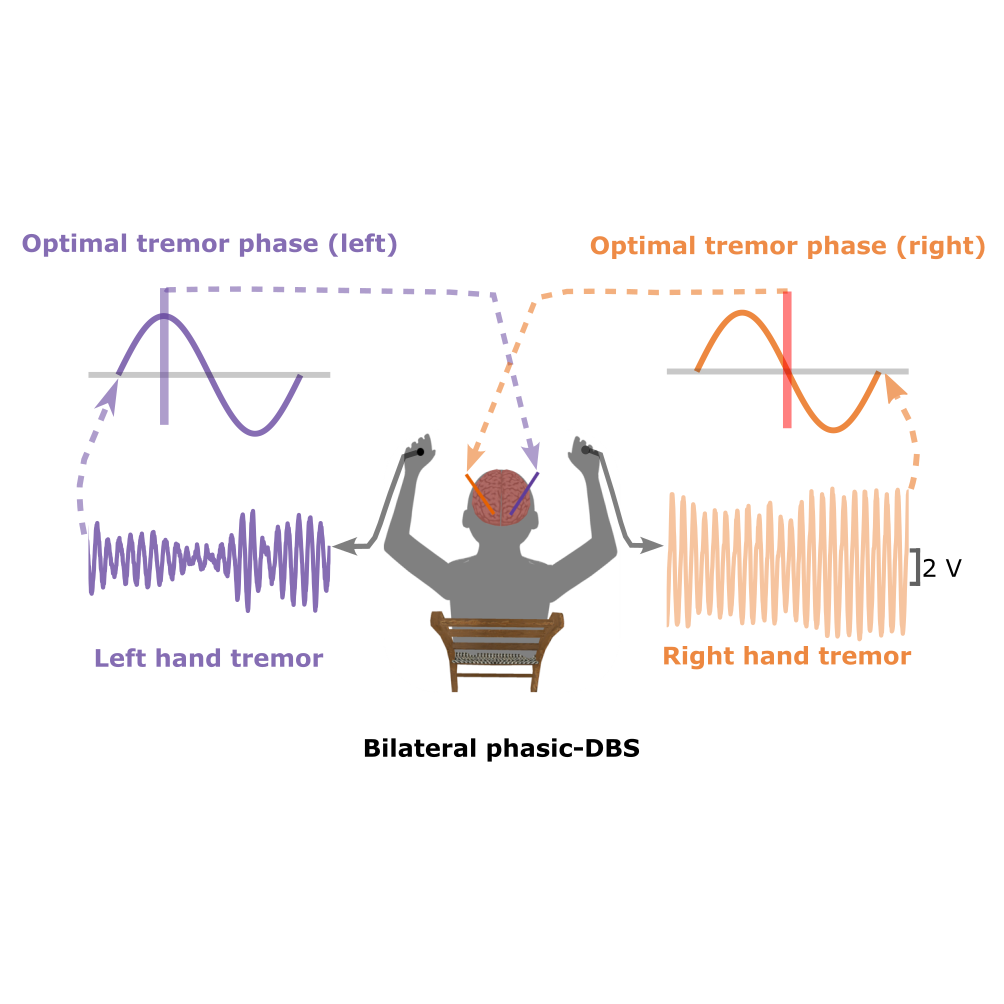
Background Tremor phase-locked deep brain stimulation (DBS) has been shown to modulate symptom severity in postural tremor, including essential and dystonic tremor, with less energy than existing systems. Previous studies focused on unilateral stimulation; it remains unknown how tremor asymmetry interacts with stimulation in the context of bilateral phase-locked DBS.
Methods Archival limb acceleration from nine essential tremor patients was analyzed for asymmetries in tremor amplitude, frequency, and instability, and their relationship with continuous high-frequency DBS (cDBS). Bilateral phase-locked DBS was tested in one essential tremor and one dystonic tremor patient.
Results Postural tremor is asymmetric, with larger tremor power linked to smaller amplitude and frequency instability in one hand. These asymmetries were significantly reduced during cDBS, with greater effects on larger amplitude tremors. Bilateral phasic DBS effects were also asymmetric.
Conclusions This study enhances understanding of tremor asymmetry and its relationship with DBS, offering insights for patient-specific tremor treatments.
Similar content
Dithering suppresses half-harmonic neural synchronisation to photic stimulation in humans.
Frequency-specific and spatiotemporal dynamics of β-γ phase-amplitude coupling in Parkinson's disease.
Characterising motor and cognitive contributions of cortical beta oscillations and their modulation with rTMS.
Flexible and Stable Cycle-by-Cycle Phase-Locked Deep Brain Stimulation System Targeting Brain Oscillations in the Management of Movement Disorders
Citation
DOI
Free Full Text at Europe PMC
PMC12485572Downloads
Tremor Asymmetry and the Development of Bilateral Phase-Specific Deep Brain Stimulation for Postural Tremor.
Postural tremor is a common symptom in movement disorders. This study shows that postural tremors are often uneven, with one hand exhibiting stronger and more stable tremor. Deep brain stimulation (DBS) can help reduce this imbalance. A new DBS approach that matches tremor timing (‘phase’) in each hand separately may be more effective than standard DBS for relieving postural tremor.
Scientific Abstract
Background Tremor phase-locked deep brain stimulation (DBS) has been shown to modulate symptom severity in postural tremor, including essential and dystonic tremor, with less energy than existing systems. Previous studies focused on unilateral stimulation; it remains unknown how tremor asymmetry interacts with stimulation in the context of bilateral phase-locked DBS.
Methods Archival limb acceleration from nine essential tremor patients was analyzed for asymmetries in tremor amplitude, frequency, and instability, and their relationship with continuous high-frequency DBS (cDBS). Bilateral phase-locked DBS was tested in one essential tremor and one dystonic tremor patient.
Results Postural tremor is asymmetric, with larger tremor power linked to smaller amplitude and frequency instability in one hand. These asymmetries were significantly reduced during cDBS, with greater effects on larger amplitude tremors. Bilateral phasic DBS effects were also asymmetric.
Conclusions This study enhances understanding of tremor asymmetry and its relationship with DBS, offering insights for patient-specific tremor treatments.
Citation
DOI
Free Full Text at Europe PMC
PMC12485572Downloads