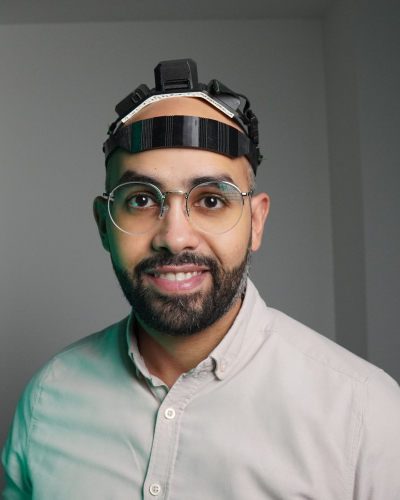
Mahmoud Abdellahi

I studied computer science during my bachelor’s and master’s degrees when I worked on signal processing, multi-variate data analyses, and machine learning; these were coupled with neuroscience and psychology during my PhD.
My research at NaPS involves the analyses of EEG signals during wake and sleep, and building pipelines for the sake of detecting memory reactivation in human sleep, and studying the characteristics of this reactivation. We have done this in both SWS and REM sleep, and we were able to relate this reactivation to sleep phenomena, such as sleep spindles, slow oscillations, and theta activity to know when to optimally deliver cues to elicit reactivation.
I worked on EEG methods to understand how the human brain processes loudness information at University College London (UCL).
I am an AI lecturer at Cairo University, where I teach brain computer interfacing, supervised learning, machine learning and deep learning, Natural language processing.
I developed a Matlab toolbox for the analysis of EEG signals and multivariate data. This toolbox can be used to perform several steps from segmenting and cleaning data all the way to applying machine and deep learning models and reporting results and statistically correcting for multiple comparisons, I have explained some of its functionality and provided some tutorials as videos. It is now available along with examples and description on GitHub.
My research aligns with CoRE's vision, as I have 10 years of experience developing AI models and have created my own MATLAB toolbox for analysing neural time series data. I am specifically interested in exploring how to identify generalisable features across participants in order to discover biomarkers that are common between people. I aim to investigate this using deep learning, focusing on non-linear mappings of shared features into latent spaces. This approach has the potential to be employed across different modalities, for example to understand memory reactivation during sleep, and it could also be used for the early diagnosis of certain conditions. I am also developing AI models to detect differences in the reactivation of emotional memories, in collaboration with Tim Denison’s team at Oxford, using a wearable headband.