Transcription factors FOXA1 and FOXA2 maintain dopaminergic neuronal properties and control feeding behavior in adult mice.

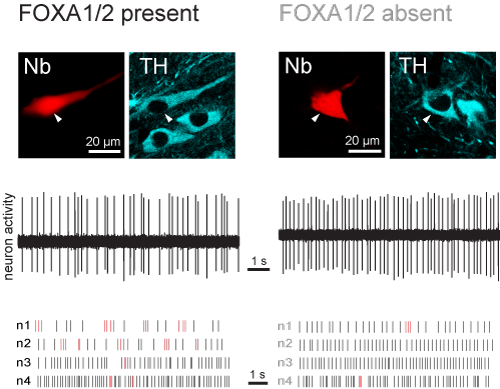
Transcription factors are proteins that help regulate gene expression in cells. Here, we show that the transcription factors FOXA1/2 are needed to sustain the functions of nerve cells in the adult brain that produce the messenger molecule dopamine. Absence of FOXA1/2 in these nerve cells affects their normal gene expression, and chemical and electrical signalling, and also alters animal behaviour.
Scientific Abstract
Midbrain dopaminergic (mDA) neurons are implicated in cognitive functions, neuropsychiatric disorders, and pathological conditions; hence understanding genes regulating their homeostasis has medical relevance. Transcription factors FOXA1 and FOXA2 (FOXA1/2) are key determinants of mDA neuronal identity during development, but their roles in adult mDA neurons are unknown. We used a conditional knockout strategy to specifically ablate FOXA1/2 in mDA neurons of adult mice. We show that deletion of Foxa1/2 results in down-regulation of tyrosine hydroxylase, the rate-limiting enzyme of dopamine (DA) biosynthesis, specifically in dopaminergic neurons of the substantia nigra pars compacta (SNc). In addition, DA synthesis and striatal DA transmission were reduced after Foxa1/2 deletion. Furthermore, the burst-firing activity characteristic of SNc mDA neurons was drastically reduced in the absence of FOXA1/2. These molecular and functional alterations lead to a severe feeding deficit in adult Foxa1/2 mutant mice, independently of motor control, which could be rescued by L-DOPA treatment. FOXA1/2 therefore control the maintenance of molecular and physiological properties of SNc mDA neurons and impact on feeding behavior in adult mice.
Similar content
Anxa1+ dopamine neuron vulnerability defines prodromal Parkinson’s disease bradykinesia and procedural motor learning impairment
Selective innervation of subpopulations of striatal neurons by distinct sets of neurons of the external globus pallidus
Citation
Free Full Text at Europe PMC
PMC4568236Downloads
Transcription factors FOXA1 and FOXA2 maintain dopaminergic neuronal properties and control feeding behavior in adult mice.
Transcription factors are proteins that help regulate gene expression in cells. Here, we show that the transcription factors FOXA1/2 are needed to sustain the functions of nerve cells in the adult brain that produce the messenger molecule dopamine. Absence of FOXA1/2 in these nerve cells affects their normal gene expression, and chemical and electrical signalling, and also alters animal behaviour.
Scientific Abstract
Midbrain dopaminergic (mDA) neurons are implicated in cognitive functions, neuropsychiatric disorders, and pathological conditions; hence understanding genes regulating their homeostasis has medical relevance. Transcription factors FOXA1 and FOXA2 (FOXA1/2) are key determinants of mDA neuronal identity during development, but their roles in adult mDA neurons are unknown. We used a conditional knockout strategy to specifically ablate FOXA1/2 in mDA neurons of adult mice. We show that deletion of Foxa1/2 results in down-regulation of tyrosine hydroxylase, the rate-limiting enzyme of dopamine (DA) biosynthesis, specifically in dopaminergic neurons of the substantia nigra pars compacta (SNc). In addition, DA synthesis and striatal DA transmission were reduced after Foxa1/2 deletion. Furthermore, the burst-firing activity characteristic of SNc mDA neurons was drastically reduced in the absence of FOXA1/2. These molecular and functional alterations lead to a severe feeding deficit in adult Foxa1/2 mutant mice, independently of motor control, which could be rescued by L-DOPA treatment. FOXA1/2 therefore control the maintenance of molecular and physiological properties of SNc mDA neurons and impact on feeding behavior in adult mice.
Citation
Free Full Text at Europe PMC
PMC4568236Downloads