Thalamo-frontal functional connectivity patterns in Tourette Syndrome: Insights from combined intracranial DBS and EEG recordings.


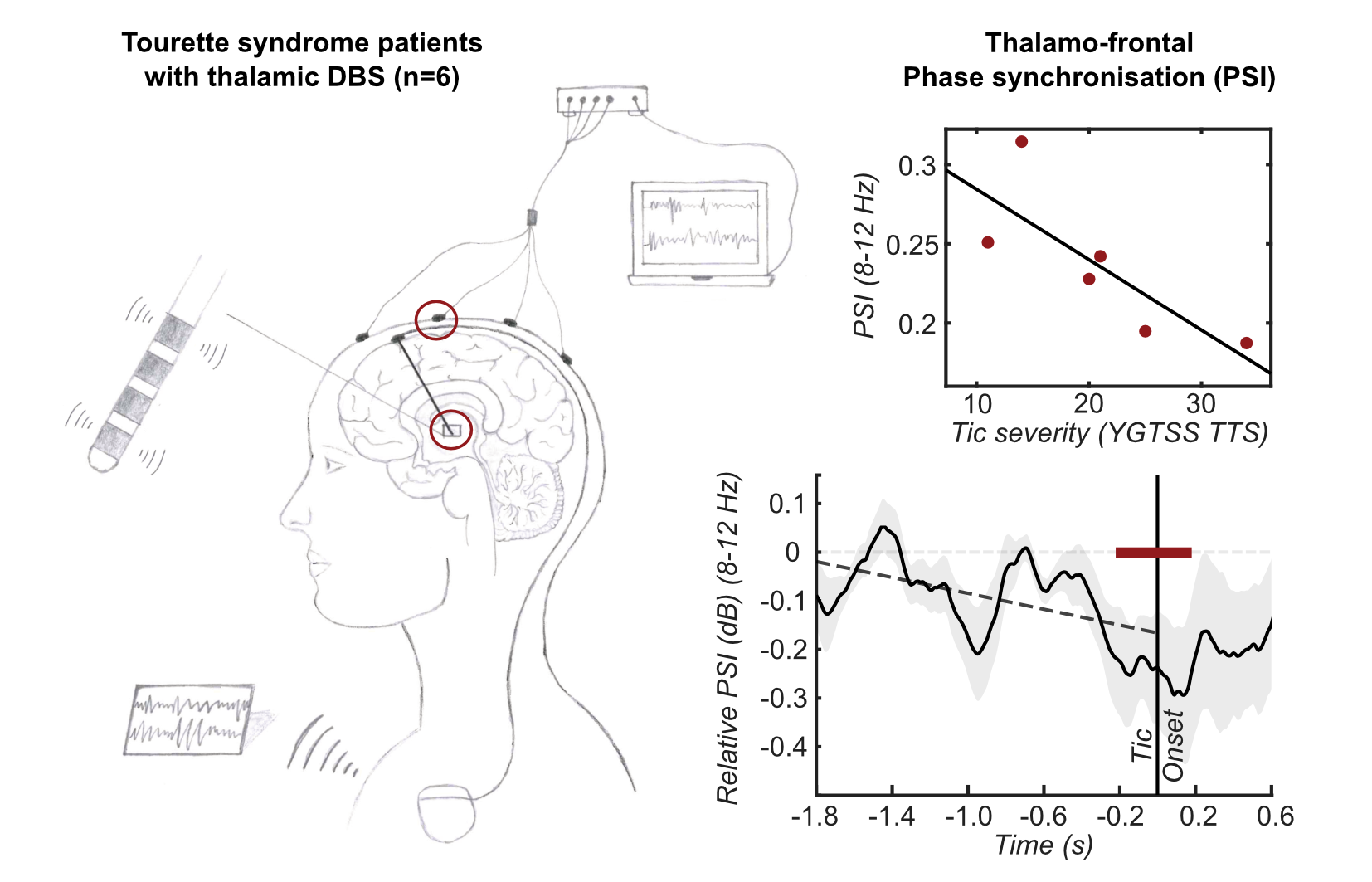
Tourette Syndrome is a condition that causes people to make sudden movements or sounds, called tics. In this study, we looked at how brain regions communicate in people with Tourette Syndrome. We found unique patterns between the thalamus and cortex linked to symptom severity and tic onset—patterns not seen by looking at brain activity in these regions alone. These insights may help develop more personalised brain stimulation treatments for Tourette Syndrome.
Scientific Abstract
Similar content
Dithering suppresses half-harmonic neural synchronisation to photic stimulation in humans.
Frequency-specific and spatiotemporal dynamics of β-γ phase-amplitude coupling in Parkinson's disease.
Characterising motor and cognitive contributions of cortical beta oscillations and their modulation with rTMS.
Flexible and Stable Cycle-by-Cycle Phase-Locked Deep Brain Stimulation System Targeting Brain Oscillations in the Management of Movement Disorders
Citation
DOI
Free Full Text at Europe PMC
PMC12700786Downloads
Thalamo-frontal functional connectivity patterns in Tourette Syndrome: Insights from combined intracranial DBS and EEG recordings.
Tourette Syndrome is a condition that causes people to make sudden movements or sounds, called tics. In this study, we looked at how brain regions communicate in people with Tourette Syndrome. We found unique patterns between the thalamus and cortex linked to symptom severity and tic onset—patterns not seen by looking at brain activity in these regions alone. These insights may help develop more personalised brain stimulation treatments for Tourette Syndrome.
Scientific Abstract
Citation
DOI
Free Full Text at Europe PMC
PMC12700786Downloads