Spatiotemporal signal space separation for regions of interest: Application for extracting neuromagnetic responses evoked by deep brain stimulation.



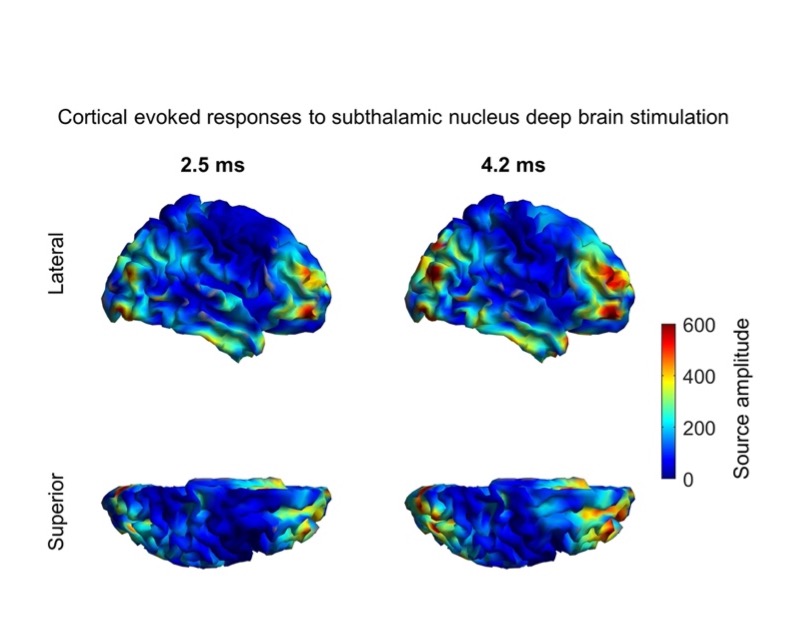
Magnetoencephalography (MEG) is a non-invasive imaging technique which allows us to understand how brain networks are modulated by therapies such as Deep Brain Stimulation (DBS). Major drawbacks of MEG are: 1) high sensitivity to DBS artefacts, and 2) limited spatial resolution due to the spread of inferred brain activity. We develop techniques to address these shortcomings and reveal how DBS may modulate brain networks at short timescales.
Scientific Abstract
Similar content
Phase-targeted modulation of essential tremor with transcranial magnetic stimulation of motor cortex
Dynamic neural states underpin bradykinesia severity in Parkinsons disease
Dynamic neural states underpin motor symptom severity in Parkinson's disease: a longitudinal analysis of chronic cortico-subthalamic nucleus recordings.
Citation
DOI
Free Full Text at Europe PMC
PMC10826894External Content
Downloads
Spatiotemporal signal space separation for regions of interest: Application for extracting neuromagnetic responses evoked by deep brain stimulation.
Magnetoencephalography (MEG) is a non-invasive imaging technique which allows us to understand how brain networks are modulated by therapies such as Deep Brain Stimulation (DBS). Major drawbacks of MEG are: 1) high sensitivity to DBS artefacts, and 2) limited spatial resolution due to the spread of inferred brain activity. We develop techniques to address these shortcomings and reveal how DBS may modulate brain networks at short timescales.
Scientific Abstract
Citation
DOI
Free Full Text at Europe PMC
PMC10826894External Content
Downloads