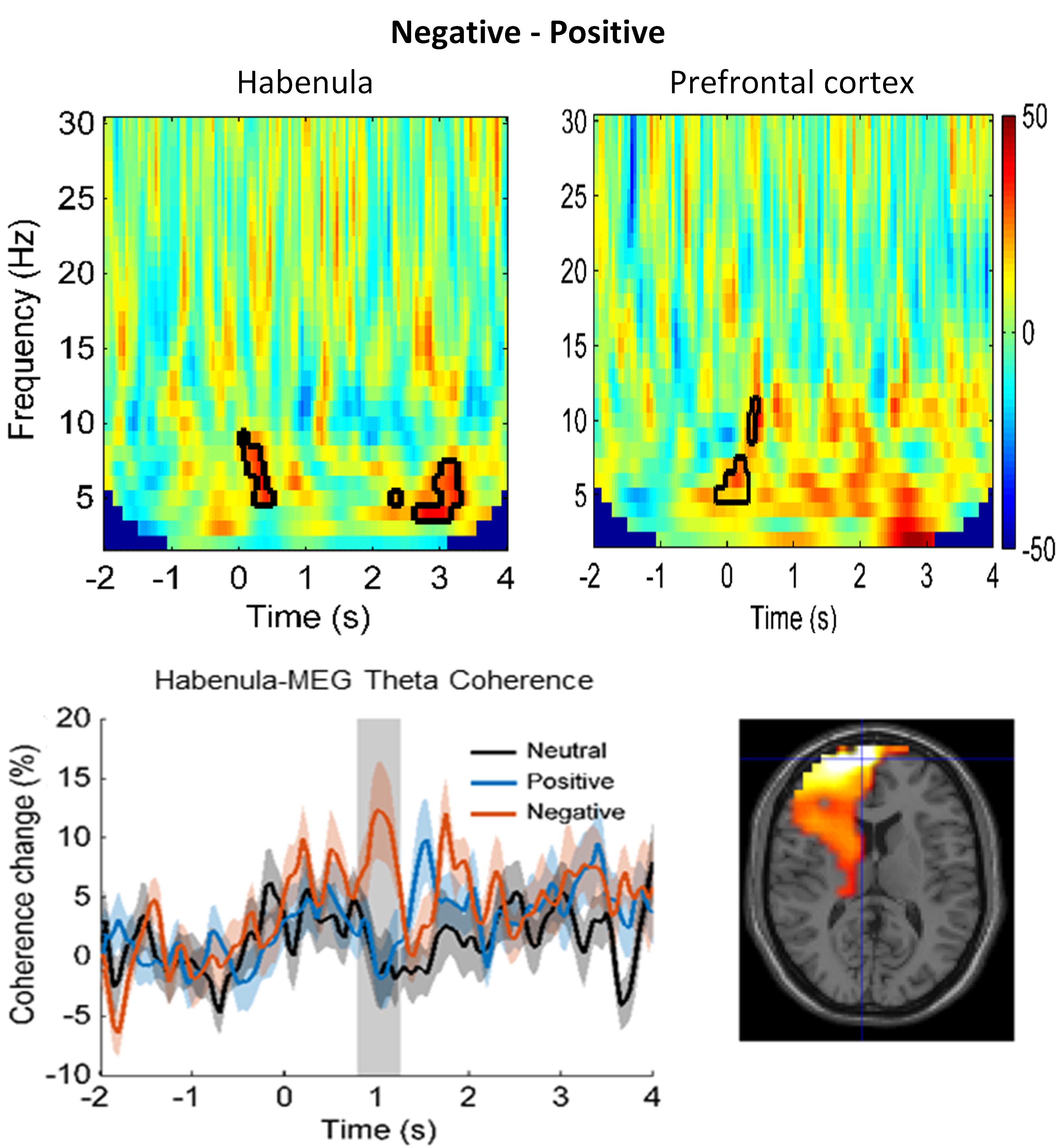
Increased theta/alpha synchrony in the habenula-prefrontal network with negative emotional stimuli in human patients.


Understanding how emotional stimuli affect brain activity can offer insights into psychiatric disorders. Here, we observed brief increases in special brain rhythms when people with psychiatric disorders viewed unpleasant pictures as compared to pleasant pictures. Our results suggest that rhythmic nerve cell activity in deep parts of the brain is involved in perceiving and processing negative emotions.
Scientific Abstract
Similar content
Dithering suppresses half-harmonic neural synchronisation to photic stimulation in humans.
Frequency-specific and spatiotemporal dynamics of β-γ phase-amplitude coupling in Parkinson's disease.
Characterising motor and cognitive contributions of cortical beta oscillations and their modulation with rTMS.
Flexible and Stable Cycle-by-Cycle Phase-Locked Deep Brain Stimulation System Targeting Brain Oscillations in the Management of Movement Disorders
Citation
DOI
Free Full Text at Europe PMC
PMC8275130Downloads
Increased theta/alpha synchrony in the habenula-prefrontal network with negative emotional stimuli in human patients.
Understanding how emotional stimuli affect brain activity can offer insights into psychiatric disorders. Here, we observed brief increases in special brain rhythms when people with psychiatric disorders viewed unpleasant pictures as compared to pleasant pictures. Our results suggest that rhythmic nerve cell activity in deep parts of the brain is involved in perceiving and processing negative emotions.
Scientific Abstract
Citation
DOI
Free Full Text at Europe PMC
PMC8275130Downloads