ePC: Fast and Deep Predictive Coding in Digital Simulation


The brain can learn with fewer repetitions of information that artificial neural networks. This property is captured by a model of the brain called predictive coding, but simulating predictive coding networks is currently slower than artificial neural networks. This paper describes a fast method for simulating predictive coding networks.
Scientific Abstract
Predictive Coding (PC) offers a brain-inspired alternative to backpropagation for neural network training, described as a physical system minimizing its internal energy. While ideally suited for analog implementation, such hardware does not exist yet, and thus, in practice, PC is predominantly digitally simulated, requiring excessive amounts of compute while struggling to scale to deeper architectures.
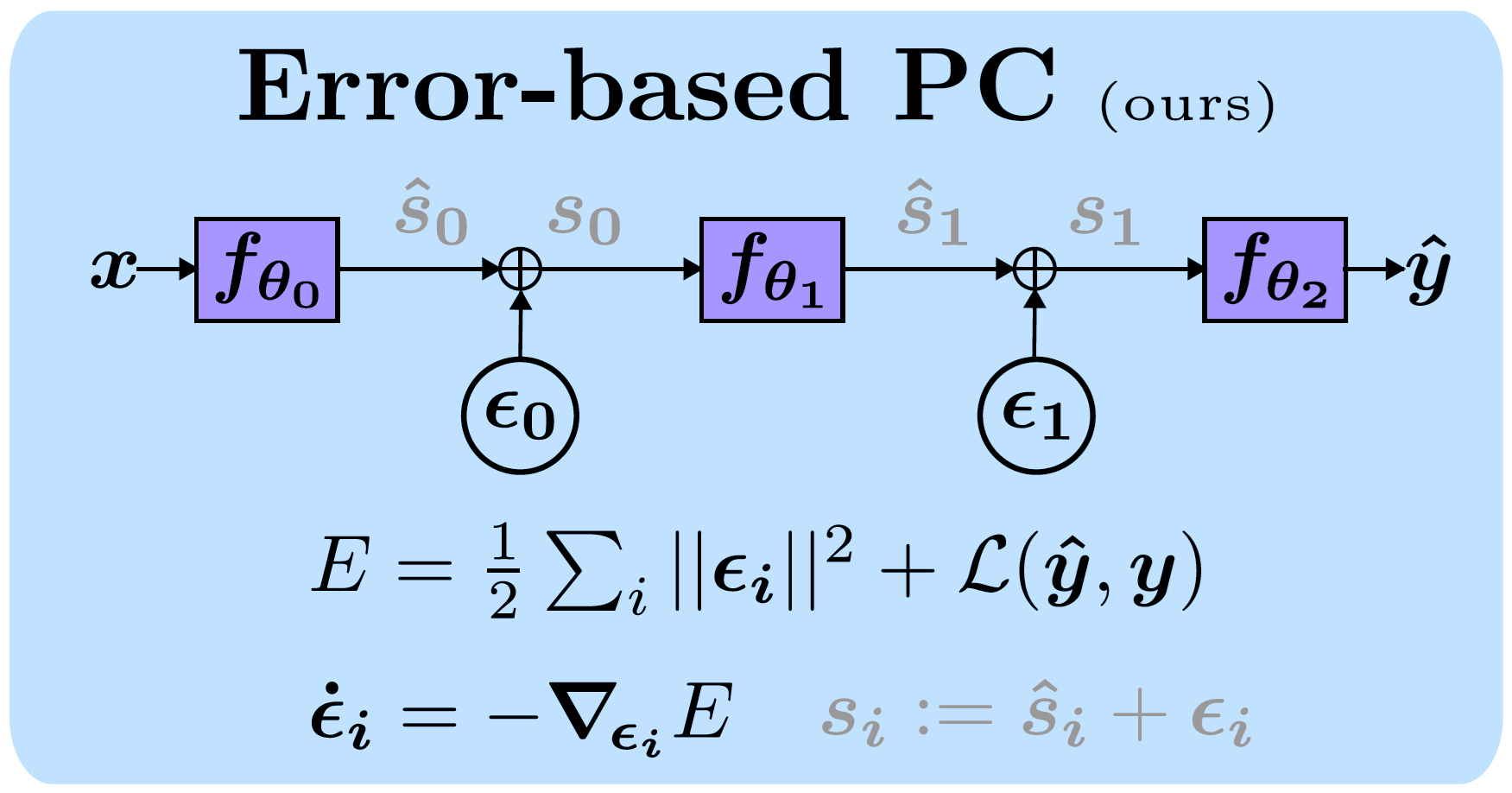
This paper reformulates PC to overcome this hardware-algorithm mismatch. First, we uncover how the canonical state-based formulation of PC (sPC) is, by design, deeply inefficient in digital simulation, inevitably resulting in exponential signal decay that stalls the entire numerical process. Then, to overcome this fundamental limitation, we introduce error-based PC (ePC), a novel reparameterization of PC which does not suffer from signal decay. Though no longer directly implementable in analog, ePC numerically computes exact PC weights gradients and runs orders of magnitude faster than sPC.
Experiments across multiple architectures and datasets demonstrate that ePC matches backpropagation’s performance even for deeper models where sPC struggles. Besides practical improvements, our work provides theoretical insight into PC dynamics and establishes a foundation for scaling PC-based learning to deeper architectures indigital simulation and beyond.
Similar content
ePC: Fast and Deep Predictive Coding in Digital Simulation
On the Infinite Width and Depth Limits of Predictive Coding Networks
Temporally distinct reward and action prediction error signals during value learning and habit formation
Normative Networks for Source Separation via Local Plasticity and Dendritic Computation
Citation
External Content
Downloads
ePC: Fast and Deep Predictive Coding in Digital Simulation
The brain can learn with fewer repetitions of information that artificial neural networks. This property is captured by a model of the brain called predictive coding, but simulating predictive coding networks is currently slower than artificial neural networks. This paper describes a fast method for simulating predictive coding networks.
Scientific Abstract
Predictive Coding (PC) offers a brain-inspired alternative to backpropagation for neural network training, described as a physical system minimizing its internal energy. While ideally suited for analog implementation, such hardware does not exist yet, and thus, in practice, PC is predominantly digitally simulated, requiring excessive amounts of compute while struggling to scale to deeper architectures.
This paper reformulates PC to overcome this hardware-algorithm mismatch. First, we uncover how the canonical state-based formulation of PC (sPC) is, by design, deeply inefficient in digital simulation, inevitably resulting in exponential signal decay that stalls the entire numerical process. Then, to overcome this fundamental limitation, we introduce error-based PC (ePC), a novel reparameterization of PC which does not suffer from signal decay. Though no longer directly implementable in analog, ePC numerically computes exact PC weights gradients and runs orders of magnitude faster than sPC.
Experiments across multiple architectures and datasets demonstrate that ePC matches backpropagation’s performance even for deeper models where sPC struggles. Besides practical improvements, our work provides theoretical insight into PC dynamics and establishes a foundation for scaling PC-based learning to deeper architectures indigital simulation and beyond.
Citation
External Content
Downloads