Noradrenaline causes a spread of association in the hippocampal cognitive map


Koolschijn RS
Parthasarathy P
Browning M
Capitão L
Clarke WT
Vogels TP
O’Reilly JX

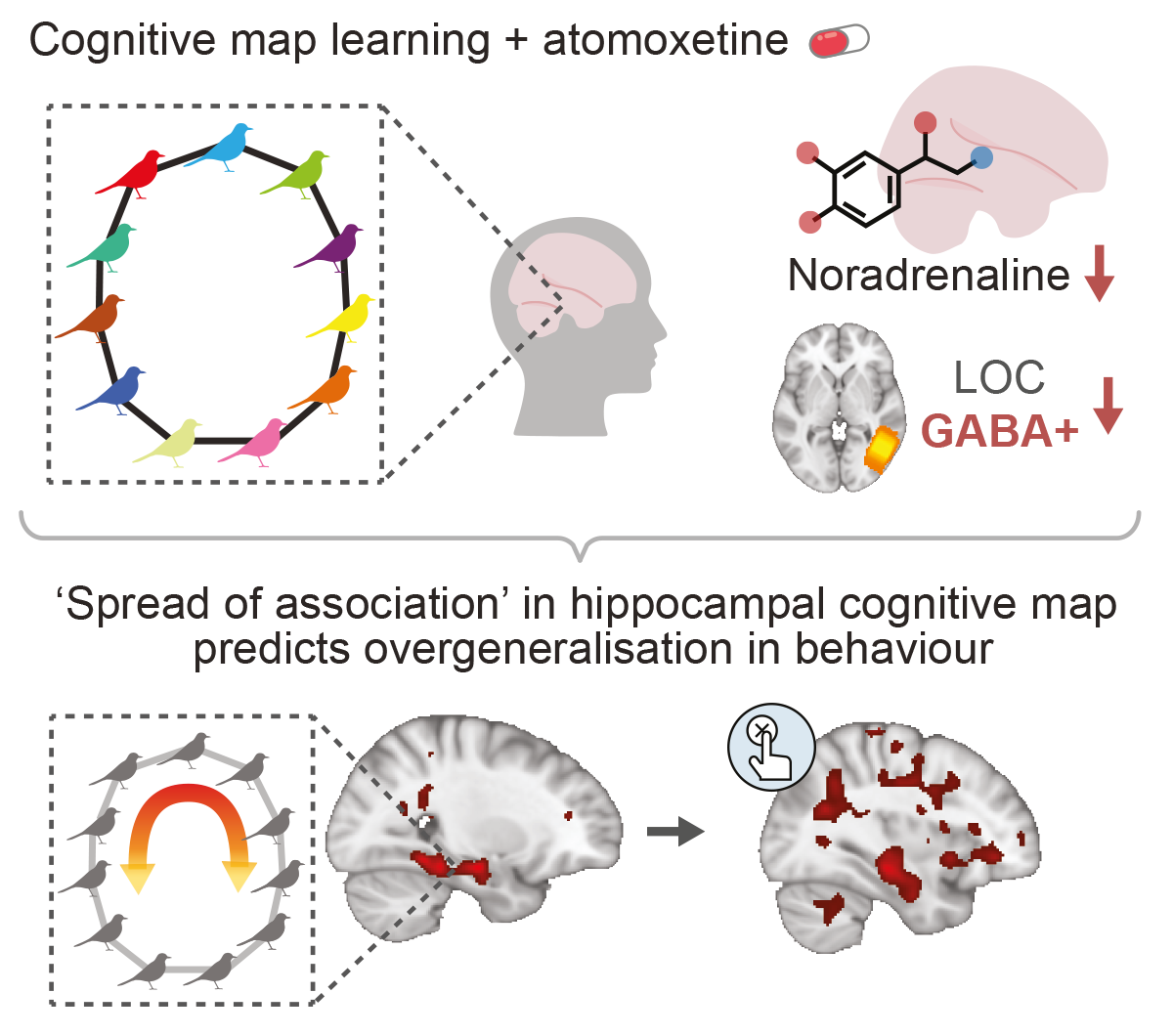
When forming a cognitive map, a trade-off exists between facilitating novel inferences and storing exact copies of past experience. Using a drug intervention in humans together with neuroimaging and  neural network modelling, we show that the neuromodulator noradrenaline sets this trade-off by increasing the spread of association across the hippocampal cognitive map and causing overgeneralisation across memories.

Scientific Abstract

The mammalian brain organises knowledge about entities in the world and relationships between them using cognitive maps. When forming a cognitive map, there is a necessary trade-off between extending the map to make novel inferences, and storing a veridical copy of past experience. However, the neural mechanisms that control this trade-off remain unknown. Using a cross-scale approach that combines a pharmacological intervention in humans with neural network modelling, we show that the neuromodulator noradrenaline elicits a significant ‘spread of association’ across hippocampal cognitive maps. This neural spread of association can be explained by changes in synaptic plasticity that predict overgeneralisation in behaviour. Thus, elevated noradrenaline during learning increases the ‘smoothing kernel’ for plasticity across the cognitive map, allowing disparate memories to become linked and distorted.

Similar content

Preprint
Causse AA, Curot J, Lopes-Dos-Santos V, Nunes-da-Silva R, Barron HC, Dornier V, Denuelle M, De Barros A, Sol J, Lotterie J, Lehongre K, Fernandez-Vidal S, Frazzini V, Navarro V, Valton L, Barbeau EJ, Denison T, Reddy L, Dupret D

A learning-evoked slow-oscillatory architecture paces population activity for offline reactivation across the human medial temporal lobe

Preprint
Nandi T, Puonti O, Clarke WT, Nettekoven CR, Barron HC, Kolasinski J, Hanayik T, Hinson EL, Berrington A, Bachtiar V, Johnstone A, Winkler AM, Thielscher A, Johansen-Berg H, Stagg CJ

tDCS induced GABA change is associated with the simulated electric field in M1, an effect mediated by grey matter volume in the MRS voxel

Preprint
Ekhtiari H, Ghobadi-Azbari P, Thielscher A, Antal A, Li LM, Shereen AD, Cabral-Calderin Y, Keeser D, Bergmann TO, Jamil A, Violante IR, Almeida J, Meinzer M, Siebner HR, Woods AJ, Stagg CJ, Abend R, Antonenko D, Auer T, Bächinger M, Baeken C, Barron HC, Chase HW, Crinion J, Datta A, Davis MH, Ebrahimi M, Esmaeilpour Z, Falcone B, Fiori V, Ghodratitoostani I, Gilam G, Grabner RH, Greenspan JD, Groen G, Hartwigsen G, Hauser TU, Herrmann CS, Juan CH, Krekelberg B, Lefebvre S, Liew SL, Madsen KH, Mahdavifar-Khayati R, Malmir N, Marangolo P, Martin AK, Meeker TJ, Ardabili HM, Moisa M, Momi D, Mulyana B, Opitz A, Orlov N, Ragert P, Ruff CC, Ruffini G, Ruttorf M, Sangchooli A, Schellhorn K, Schlaug G, Sehm B, Soleimani G, Tavakoli H, Thompson B, Timmann D, Tsuchiyagaito A, Ulrich M, Vosskuhl J, Weinrich CA, Zare-Bidoky M, Zhang X, Zoefel B, Nitsche MA, Bikson M

A Checklist for Assessing the Methodological Quality of Concurrent tES-fMRI Studies (ContES Checklist): A Consensus Study and Statement

Noradrenaline causes a spread of association in the hippocampal cognitive map

Koolschijn RS
Parthasarathy P
Browning M
Capitão L
Clarke WT
Vogels TP
O’Reilly JX

When forming a cognitive map, a trade-off exists between facilitating novel inferences and storing exact copies of past experience. Using a drug intervention in humans together with neuroimaging and  neural network modelling, we show that the neuromodulator noradrenaline sets this trade-off by increasing the spread of association across the hippocampal cognitive map and causing overgeneralisation across memories.

Scientific Abstract

The mammalian brain organises knowledge about entities in the world and relationships between them using cognitive maps. When forming a cognitive map, there is a necessary trade-off between extending the map to make novel inferences, and storing a veridical copy of past experience. However, the neural mechanisms that control this trade-off remain unknown. Using a cross-scale approach that combines a pharmacological intervention in humans with neural network modelling, we show that the neuromodulator noradrenaline elicits a significant ‘spread of association’ across hippocampal cognitive maps. This neural spread of association can be explained by changes in synaptic plasticity that predict overgeneralisation in behaviour. Thus, elevated noradrenaline during learning increases the ‘smoothing kernel’ for plasticity across the cognitive map, allowing disparate memories to become linked and distorted.

Citation

Nat Commun, Epub ahead of Print (2026)

DOI

10.1038/s41467-026-70659-x

Downloads

View PDF (2MB)

Similar content

Preprint
Causse AA, Curot J, Lopes-Dos-Santos V, Nunes-da-Silva R, Barron HC, Dornier V, Denuelle M, De Barros A, Sol J, Lotterie J, Lehongre K, Fernandez-Vidal S, Frazzini V, Navarro V, Valton L, Barbeau EJ, Denison T, Reddy L, Dupret D

A learning-evoked slow-oscillatory architecture paces population activity for offline reactivation across the human medial temporal lobe

Preprint
Nandi T, Puonti O, Clarke WT, Nettekoven CR, Barron HC, Kolasinski J, Hanayik T, Hinson EL, Berrington A, Bachtiar V, Johnstone A, Winkler AM, Thielscher A, Johansen-Berg H, Stagg CJ

tDCS induced GABA change is associated with the simulated electric field in M1, an effect mediated by grey matter volume in the MRS voxel

Preprint
Ekhtiari H, Ghobadi-Azbari P, Thielscher A, Antal A, Li LM, Shereen AD, Cabral-Calderin Y, Keeser D, Bergmann TO, Jamil A, Violante IR, Almeida J, Meinzer M, Siebner HR, Woods AJ, Stagg CJ, Abend R, Antonenko D, Auer T, Bächinger M, Baeken C, Barron HC, Chase HW, Crinion J, Datta A, Davis MH, Ebrahimi M, Esmaeilpour Z, Falcone B, Fiori V, Ghodratitoostani I, Gilam G, Grabner RH, Greenspan JD, Groen G, Hartwigsen G, Hauser TU, Herrmann CS, Juan CH, Krekelberg B, Lefebvre S, Liew SL, Madsen KH, Mahdavifar-Khayati R, Malmir N, Marangolo P, Martin AK, Meeker TJ, Ardabili HM, Moisa M, Momi D, Mulyana B, Opitz A, Orlov N, Ragert P, Ruff CC, Ruffini G, Ruttorf M, Sangchooli A, Schellhorn K, Schlaug G, Sehm B, Soleimani G, Tavakoli H, Thompson B, Timmann D, Tsuchiyagaito A, Ulrich M, Vosskuhl J, Weinrich CA, Zare-Bidoky M, Zhang X, Zoefel B, Nitsche MA, Bikson M

A Checklist for Assessing the Methodological Quality of Concurrent tES-fMRI Studies (ContES Checklist): A Consensus Study and Statement