The subthalamic nucleus during decision-making with multiple alternatives.

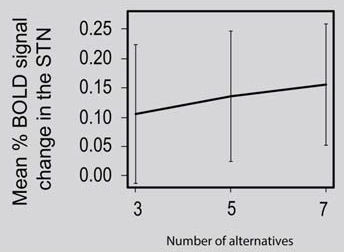
It has been proposed that a part of the brain called the subthalamic nucleus slows down the selection of actions when conflicting information is provided. In agreement with the predictions of this theory, we show in this experiment that activity in the human subthalamic nucleus is increased with the number of available alternative choices in a decision-making task.
Scientific Abstract
Several prominent neurocomputational models predict that an increase of choice alternatives is modulated by increased activity in the subthalamic nucleus (STN). In turn, increased STN activity allows prolonged accumulation of information. At the same time, areas in the medial frontal cortex such as the anterior cingulate cortex (ACC) and the pre-SMA are hypothesized to influence the information processing in the STN. This study set out to test concrete predictions of STN activity in multiple-alternative decision-making using a multimodal combination of 7 Tesla structural and functional Magnetic Resonance Imaging, and ancestral graph (AG) modeling. The results are in line with the predictions in that increased STN activity was found with an increasing amount of choice alternatives. In addition, our study shows that activity in the ACC is correlated with activity in the STN without directly modulating it. This result sheds new light on the information processing streams between medial frontal cortex and the basal ganglia.
Similar content
Preprint
MRC CoRE in RND Output
Temporally distinct reward and action prediction error signals during value learning and habit formation
Preprint
Normative Networks for Source Separation via Local Plasticity and Dendritic Computation
Preprint
On the Infinite Width and Depth Limits of Predictive Coding Networks
The subthalamic nucleus during decision-making with multiple alternatives.
It has been proposed that a part of the brain called the subthalamic nucleus slows down the selection of actions when conflicting information is provided. In agreement with the predictions of this theory, we show in this experiment that activity in the human subthalamic nucleus is increased with the number of available alternative choices in a decision-making task.
Scientific Abstract
Several prominent neurocomputational models predict that an increase of choice alternatives is modulated by increased activity in the subthalamic nucleus (STN). In turn, increased STN activity allows prolonged accumulation of information. At the same time, areas in the medial frontal cortex such as the anterior cingulate cortex (ACC) and the pre-SMA are hypothesized to influence the information processing in the STN. This study set out to test concrete predictions of STN activity in multiple-alternative decision-making using a multimodal combination of 7 Tesla structural and functional Magnetic Resonance Imaging, and ancestral graph (AG) modeling. The results are in line with the predictions in that increased STN activity was found with an increasing amount of choice alternatives. In addition, our study shows that activity in the ACC is correlated with activity in the STN without directly modulating it. This result sheds new light on the information processing streams between medial frontal cortex and the basal ganglia.
Citation
2015.Hum Brain Mapp, 36(10):4041-4052.
Free Full Text at Europe PMC
PMC4896390Downloads
Similar content
Preprint
MRC CoRE in RND Output
Temporally distinct reward and action prediction error signals during value learning and habit formation
Preprint
Normative Networks for Source Separation via Local Plasticity and Dendritic Computation
Preprint