Recoding a cocaine-place memory engram to a neutral engram in the hippocampus.


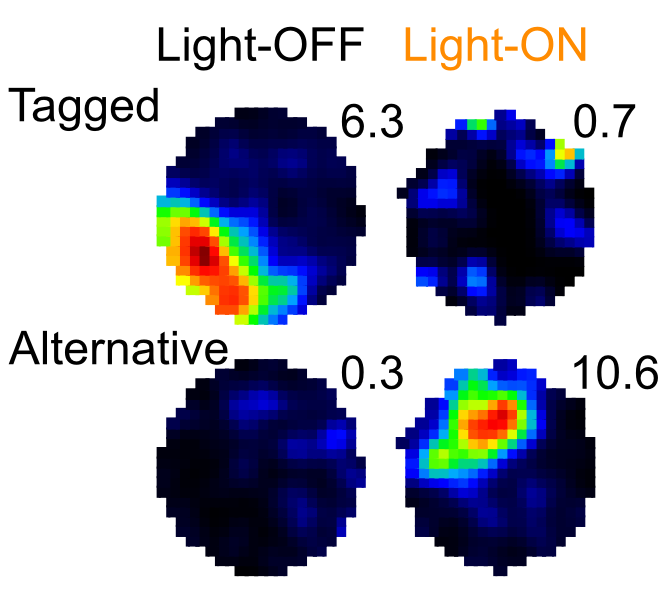
Here, Trouche and colleagues report that silencing hippocampal nerve cells active in a given environment allowed for the activation of a subset of quiet nerve cells, then enabling the emergence of an alternative information code for space. When this intervention was applied in an environment where mice had received cocaine, it cancelled an otherwise long-lasting drug-place preference.
Scientific Abstract
The hippocampus provides the brain's memory system with a subset of neurons holding a map-like representation of each environment experienced. We found in mice that optogenetic silencing those neurons active in an environment unmasked a subset of quiet neurons, enabling the emergence of an alternative map. When applied in a cocaine-paired environment, this intervention neutralized an otherwise long-lasting drug-place preference, showing that recoding a spatial memory engram can alleviate associated maladaptive behavior.
Similar content
Paper
MRC CoRE in RND Output
A learning-evoked slow-oscillatory architecture paces population activity for offline reactivation across the human medial temporal lobe
2026. Neuron (ePub ahead of print).
Preprint
A learning-evoked slow-oscillatory architecture paces population activity for offline reactivation across the human medial temporal lobe
Paper
Hippocampal Ripple Diversity organises Neuronal Reactivation Dynamics in the Offline Brain
2025. Neuron 113:1-18
Recoding a cocaine-place memory engram to a neutral engram in the hippocampus.
Here, Trouche and colleagues report that silencing hippocampal nerve cells active in a given environment allowed for the activation of a subset of quiet nerve cells, then enabling the emergence of an alternative information code for space. When this intervention was applied in an environment where mice had received cocaine, it cancelled an otherwise long-lasting drug-place preference.
Scientific Abstract
The hippocampus provides the brain's memory system with a subset of neurons holding a map-like representation of each environment experienced. We found in mice that optogenetic silencing those neurons active in an environment unmasked a subset of quiet neurons, enabling the emergence of an alternative map. When applied in a cocaine-paired environment, this intervention neutralized an otherwise long-lasting drug-place preference, showing that recoding a spatial memory engram can alleviate associated maladaptive behavior.
Citation
2016.Nat. Neurosci., 19(4):564-7.
Free Full Text at Europe PMC
PMC4817230Downloads
Similar content
Paper
MRC CoRE in RND Output
A learning-evoked slow-oscillatory architecture paces population activity for offline reactivation across the human medial temporal lobe
2026. Neuron (ePub ahead of print).
Preprint
A learning-evoked slow-oscillatory architecture paces population activity for offline reactivation across the human medial temporal lobe
Paper
Hippocampal Ripple Diversity organises Neuronal Reactivation Dynamics in the Offline Brain
2025. Neuron 113:1-18