Dopamine and Consolidation of Episodic Memory: Timing Is Everything.

The effect of dopaminergic medications on the consolidation of memory in people with Parkinson's disease depends on how soon after learning they are given the medication. Here, we show that dopaminergic medications impair early consolidation of episodic memory, but enhance late memory consolidation.
Scientific Abstract
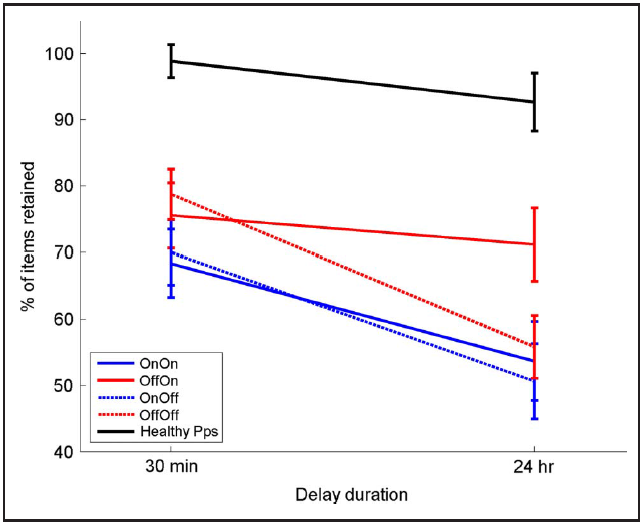
Memory consolidation underpins adaptive behavior and dopaminergic networks may be critical for prolonged, selective information storage. To understand the time course of the dopaminergic contribution to memory consolidation in humans, here we investigate the effect of dopaminergic medication on recall and recognition in the short and longer term in Parkinson disease (PD). Fifteen people with PD were each tested on or off dopaminergic medication during learning/early consolidation (Day 1) and/or late consolidation (Day 2). Fifteen age-matched healthy participants were tested only once. On Day 1 participants learned new information, and early episodic memory was tested after 30 min. Then on Day 2, recall and recognition were retested after a 24-hr delay. Participants on medication on Day 1 recalled less information at 30 min and 24 hr. In contrast, patients on medication on Day 2 (8-24 hr after learning) recalled more information at 24 hr than those off medication. Although recognition sensitivity was unaffected by medication, response bias was dependent on dopaminergic state: Medication during learning induced a more liberal bias 24 hr later, whereas patients off medication during learning were more conservative responders 24 hr later. We use computational modeling to propose possible mechanisms for this change in response bias. In summary, dopaminergic medication in PD patients during learning impairs early consolidation of episodic memory and makes delayed responses more liberal, but enhances late memory consolidation presumably through a dopamine-dependent consolidation pathway that may be active during sleep.
Similar content
Preprint
MRC CoRE in RND Output
Temporally distinct reward and action prediction error signals during value learning and habit formation
Preprint
Normative Networks for Source Separation via Local Plasticity and Dendritic Computation
Preprint
On the Infinite Width and Depth Limits of Predictive Coding Networks
Dopamine and Consolidation of Episodic Memory: Timing Is Everything.
The effect of dopaminergic medications on the consolidation of memory in people with Parkinson's disease depends on how soon after learning they are given the medication. Here, we show that dopaminergic medications impair early consolidation of episodic memory, but enhance late memory consolidation.
Scientific Abstract
Memory consolidation underpins adaptive behavior and dopaminergic networks may be critical for prolonged, selective information storage. To understand the time course of the dopaminergic contribution to memory consolidation in humans, here we investigate the effect of dopaminergic medication on recall and recognition in the short and longer term in Parkinson disease (PD). Fifteen people with PD were each tested on or off dopaminergic medication during learning/early consolidation (Day 1) and/or late consolidation (Day 2). Fifteen age-matched healthy participants were tested only once. On Day 1 participants learned new information, and early episodic memory was tested after 30 min. Then on Day 2, recall and recognition were retested after a 24-hr delay. Participants on medication on Day 1 recalled less information at 30 min and 24 hr. In contrast, patients on medication on Day 2 (8-24 hr after learning) recalled more information at 24 hr than those off medication. Although recognition sensitivity was unaffected by medication, response bias was dependent on dopaminergic state: Medication during learning induced a more liberal bias 24 hr later, whereas patients off medication during learning were more conservative responders 24 hr later. We use computational modeling to propose possible mechanisms for this change in response bias. In summary, dopaminergic medication in PD patients during learning impairs early consolidation of episodic memory and makes delayed responses more liberal, but enhances late memory consolidation presumably through a dopamine-dependent consolidation pathway that may be active during sleep.
Citation
2015.J Cogn Neurosci, 27(10):2035-50.
Free Full Text at Europe PMC
PMC4880040Downloads
Similar content
Preprint
MRC CoRE in RND Output
Temporally distinct reward and action prediction error signals during value learning and habit formation
Preprint
Normative Networks for Source Separation via Local Plasticity and Dendritic Computation
Preprint