Dopamine encoding of novelty facilitates efficient uncertainty-driven exploration.


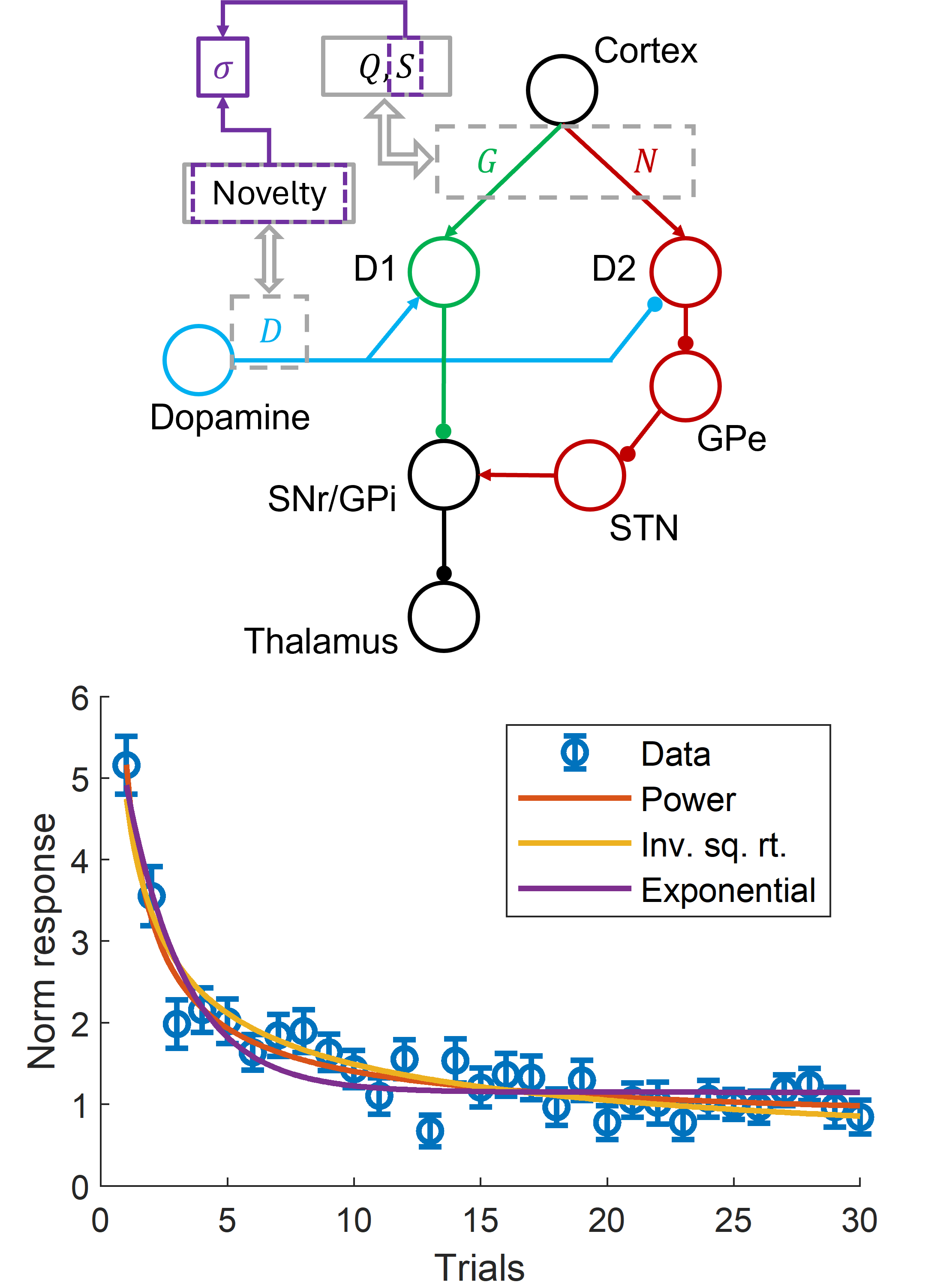
A trial-and-error process is often necessary to determine the most rewarding action in a certain context. Determining how many resources should be allocated to acquiring information (“exploration”) and how much to utilising existing information to maximise reward (“exploitation”) is key to overall effectiveness. We propose a theory whereby a deep brain area (the basal ganglia) uses an algorithm to optimally allocate resources between exploration and exploitation. We also test our theory with experimental results and assess the performance of this algorithm.
Scientific Abstract
Similar content
Normative Networks for Source Separation via Local Plasticity and Dendritic Computation
On the Infinite Width and Depth Limits of Predictive Coding Networks
Dithering suppresses half-harmonic neural synchronisation to photic stimulation in humans.
Citation
DOI
Free Full Text at Europe PMC
PMC11051659Downloads
Dopamine encoding of novelty facilitates efficient uncertainty-driven exploration.
A trial-and-error process is often necessary to determine the most rewarding action in a certain context. Determining how many resources should be allocated to acquiring information (“exploration”) and how much to utilising existing information to maximise reward (“exploitation”) is key to overall effectiveness. We propose a theory whereby a deep brain area (the basal ganglia) uses an algorithm to optimally allocate resources between exploration and exploitation. We also test our theory with experimental results and assess the performance of this algorithm.
Scientific Abstract
Citation
DOI
Free Full Text at Europe PMC
PMC11051659Downloads