Subthalamic beta-targeted neurofeedback speeds up movement initiation but increases tremor in Parkinsonian patients.

We show that people with Parkinson’s can be trained to suppress a special kind of brain activity related to their movement difficulties. We discovered that this training sped up people’s responses when prompted to move. However, the same training also made shaking (tremor) worse. Our results suggest that a person’s symptoms have to be carefully considered when trying ‘brain training’.
Scientific Abstract
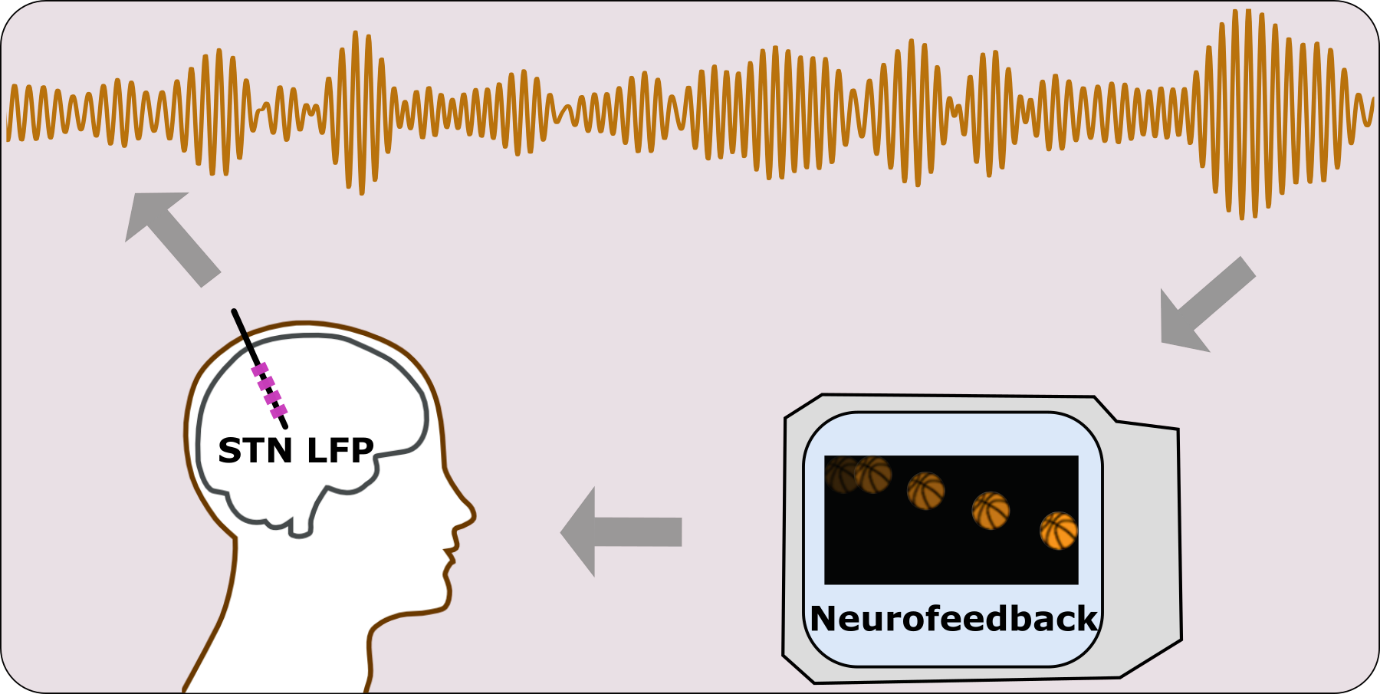
Previous studies have explored neurofeedback training for Parkinsonian patients to suppress beta oscillations in the subthalamic nucleus (STN). However, its impacts on movements and Parkinsonian tremor are unclear. We developed a neurofeedback paradigm targeting STN beta bursts and investigated whether neurofeedback training could improve motor initiation in Parkinson's disease compared to passive observation. Our task additionally allowed us to test which endogenous changes in oscillatory STN activities are associated with trial-to-trial motor performance. Neurofeedback training reduced beta synchrony and increased gamma activity within the STN, and reduced beta band coupling between the STN and motor cortex. These changes were accompanied by reduced reaction times in subsequently cued movements. However, in Parkinsonian patients with pre-existing symptoms of tremor, successful volitional beta suppression was associated with an amplification of tremor which correlated with theta band activity in STN local field potentials, suggesting an additional cross-frequency interaction between STN beta and theta activities.
Similar content
Dopamine and the dynamics of subthalamic and leg muscle activities in parkinsonian stepping.
Thalamo-frontal functional connectivity patterns in Tourette Syndrome: Insights from combined intracranial DBS and EEG recordings.
Flexible and stable cycle-by-cycle phase-locked deep brain stimulation system targeting brain oscillations in the management of movement disorders.
Beta-triggered adaptive deep brain stimulation during reaching movement in Parkinson’s disease
Citation
DOI
Free Full Text at Europe PMC
PMC7695453Downloads
Subthalamic beta-targeted neurofeedback speeds up movement initiation but increases tremor in Parkinsonian patients.
We show that people with Parkinson’s can be trained to suppress a special kind of brain activity related to their movement difficulties. We discovered that this training sped up people’s responses when prompted to move. However, the same training also made shaking (tremor) worse. Our results suggest that a person’s symptoms have to be carefully considered when trying ‘brain training’.
Scientific Abstract
Previous studies have explored neurofeedback training for Parkinsonian patients to suppress beta oscillations in the subthalamic nucleus (STN). However, its impacts on movements and Parkinsonian tremor are unclear. We developed a neurofeedback paradigm targeting STN beta bursts and investigated whether neurofeedback training could improve motor initiation in Parkinson's disease compared to passive observation. Our task additionally allowed us to test which endogenous changes in oscillatory STN activities are associated with trial-to-trial motor performance. Neurofeedback training reduced beta synchrony and increased gamma activity within the STN, and reduced beta band coupling between the STN and motor cortex. These changes were accompanied by reduced reaction times in subsequently cued movements. However, in Parkinsonian patients with pre-existing symptoms of tremor, successful volitional beta suppression was associated with an amplification of tremor which correlated with theta band activity in STN local field potentials, suggesting an additional cross-frequency interaction between STN beta and theta activities.
Citation
DOI
Free Full Text at Europe PMC
PMC7695453Downloads