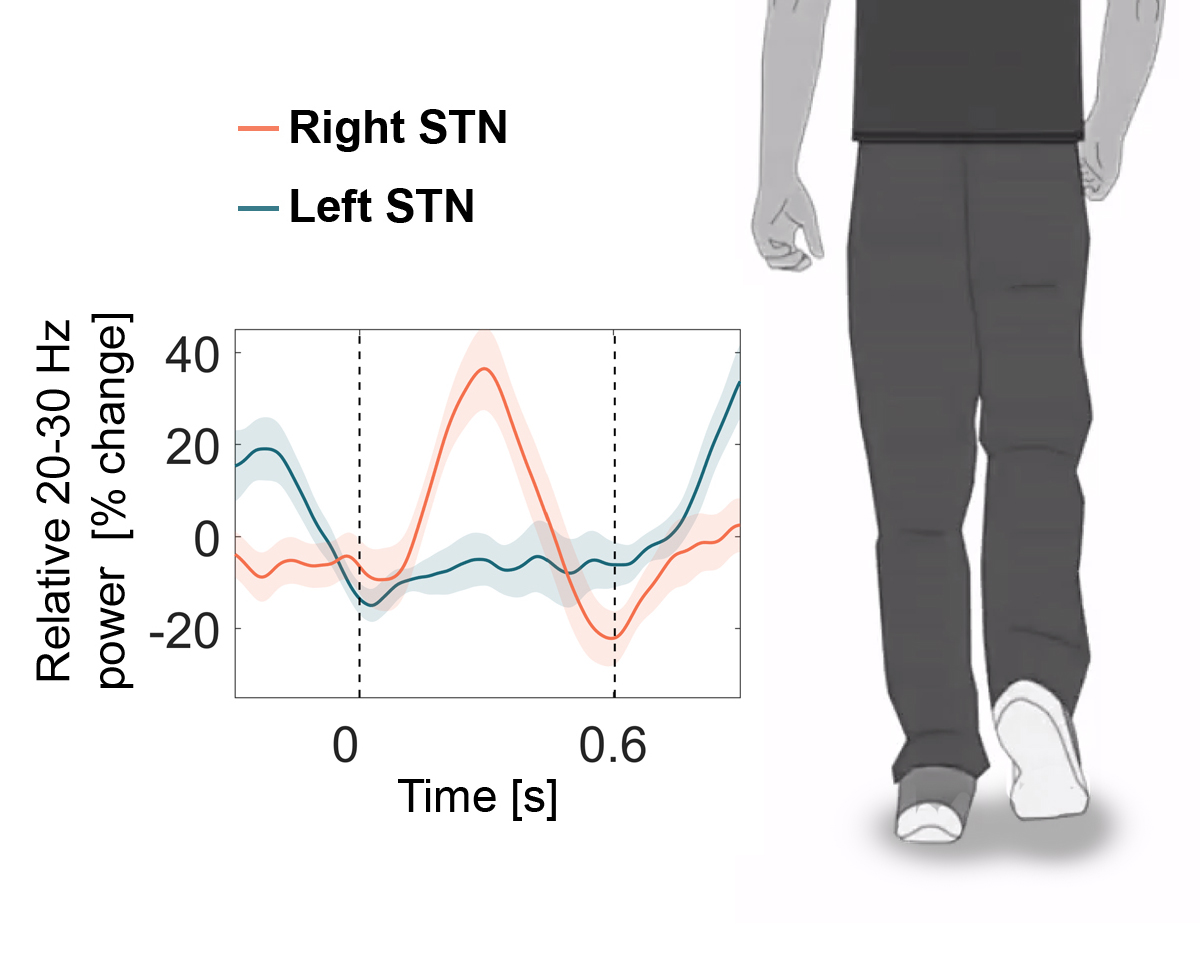
Alternating Modulation of Subthalamic Nucleus Beta Oscillations during Stepping.

People with Parkinson’s (PwP) can have difficulties with walking. Here, we recorded nerve cell activity in the brain while PwP stepped in place along with a cartoon person walking in a video. We found that brain waves varied in time with stepping, alternating between left and right sides. Our results raise the possibility that alternating brain stimulation may be useful for improving gait in PwP.
Scientific Abstract
Gait disturbances in Parkinson's disease are commonly refractory to current treatment options and majorly impair patient's quality of life. Auditory cues facilitate gait and prevent motor blocks. We investigated how neural dynamics in the human subthalamic nucleus of Parkinsons's disease patients (14 male, 2 female) vary during stepping and whether rhythmic auditory cues enhance the observed modulation. Oscillations in the beta band were suppressed after ipsilateral heel strikes, when the contralateral foot had to be raised, and reappeared after contralateral heel strikes, when the contralateral foot rested on the floor. The timing of this 20-30 Hz beta modulation was clearly distinct between the left and right subthalamic nucleus, and was alternating within each stepping cycle. This modulation was similar, whether stepping movements were made while sitting, standing, or during gait, confirming the utility of the stepping in place paradigm. During stepping in place, beta modulation increased with auditory cues that assisted patients in timing their steps more regularly. Our results suggest a link between the degree of power modulation within high beta frequency bands and stepping performance. These findings raise the possibility that alternating deep brain stimulation patterns may be superior to constant stimulation for improving parkinsonian gait.
Similar content
Dopamine and the dynamics of subthalamic and leg muscle activities in parkinsonian stepping.
Thalamo-frontal functional connectivity patterns in Tourette Syndrome: Insights from combined intracranial DBS and EEG recordings.
Flexible and stable cycle-by-cycle phase-locked deep brain stimulation system targeting brain oscillations in the management of movement disorders.
Beta-triggered adaptive deep brain stimulation during reaching movement in Parkinson’s disease
Alternating Modulation of Subthalamic Nucleus Beta Oscillations during Stepping.
People with Parkinson’s (PwP) can have difficulties with walking. Here, we recorded nerve cell activity in the brain while PwP stepped in place along with a cartoon person walking in a video. We found that brain waves varied in time with stepping, alternating between left and right sides. Our results raise the possibility that alternating brain stimulation may be useful for improving gait in PwP.
Scientific Abstract
Gait disturbances in Parkinson's disease are commonly refractory to current treatment options and majorly impair patient's quality of life. Auditory cues facilitate gait and prevent motor blocks. We investigated how neural dynamics in the human subthalamic nucleus of Parkinsons's disease patients (14 male, 2 female) vary during stepping and whether rhythmic auditory cues enhance the observed modulation. Oscillations in the beta band were suppressed after ipsilateral heel strikes, when the contralateral foot had to be raised, and reappeared after contralateral heel strikes, when the contralateral foot rested on the floor. The timing of this 20-30 Hz beta modulation was clearly distinct between the left and right subthalamic nucleus, and was alternating within each stepping cycle. This modulation was similar, whether stepping movements were made while sitting, standing, or during gait, confirming the utility of the stepping in place paradigm. During stepping in place, beta modulation increased with auditory cues that assisted patients in timing their steps more regularly. Our results suggest a link between the degree of power modulation within high beta frequency bands and stepping performance. These findings raise the possibility that alternating deep brain stimulation patterns may be superior to constant stimulation for improving parkinsonian gait.
Citation
Free Full Text at Europe PMC
PMC5977446Downloads