Mean-Field Approximations With Adaptive Coupling for Networks With Spike-Timing-Dependent Plasticity.

Adaptation of brain circuits occurs at the level of individual connections between brain cells. Here, we use mathematical models to describe the changes for a population of neurons. The reduced complexity of these mathematical models makes them better suited to develop brain stimulation procedures for novel therapies.
Scientific Abstract
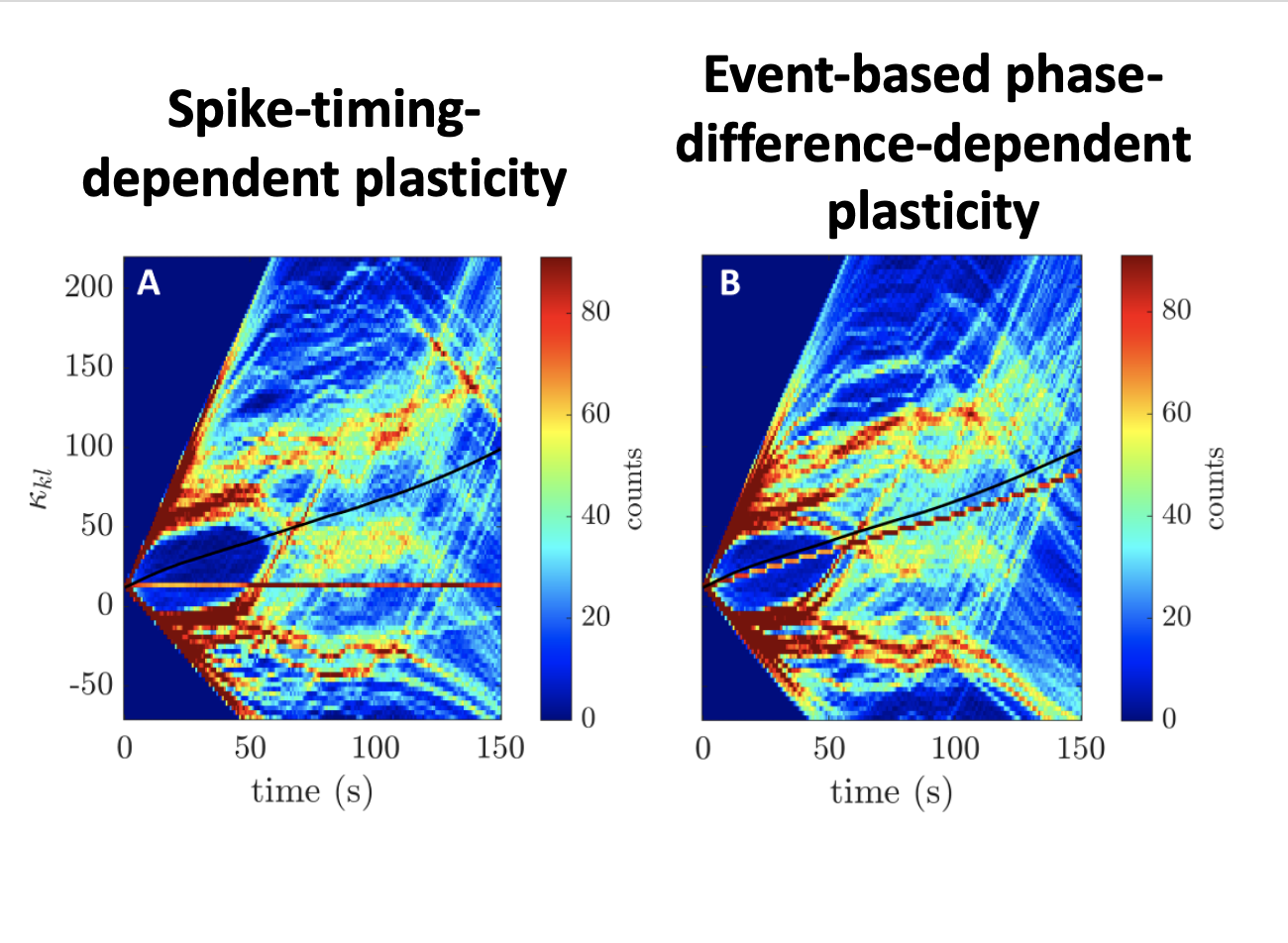
Understanding the effect of spike-timing-dependent plasticity (STDP) is key to elucidating how neural networks change over long timescales and to design interventions aimed at modulating such networks in neurological disorders. However, progress is restricted by the significant computational cost associated with simulating neural network models with STDP and by the lack of low-dimensional description that could provide analytical insights. Phase-difference-dependent plasticity (PDDP) rules approximate STDP in phase oscillator networks, which prescribe synaptic changes based on phase differences of neuron pairs rather than differences in spike timing. Here we construct mean-field approximations for phase oscillator networks with STDP to describe part of the phase space for this very high-dimensional system. We first show that single-harmonic PDDP rules can approximate a simple form of symmetric STDP, while multiharmonic rules are required to accurately approximate causal STDP. We then derive exact expressions for the evolution of the average PDDP coupling weight in terms of network synchrony. For adaptive networks of Kuramoto oscillators that form clusters, we formulate a family of low-dimensional descriptions based on the mean-field dynamics of each cluster and average coupling weights between and within clusters. Finally, we show that such a two-cluster mean-field model can be fitted to synthetic data to provide a low-dimensional approximation of a full adaptive network with symmetric STDP. Our framework represents a step toward a low-dimensional description of adaptive networks with STDP, and could for example inform the development of new therapies aimed at maximizing the long-lasting effects of brain stimulation.
Similar content
Paper
MRC CoRE in RND Output
Dithering suppresses half-harmonic neural synchronisation to photic stimulation in humans.
2026. Brain Stimul, 19(3):103111.
Free Full Text at Europe PMC
PMC13328066
Preprint
Dithering suppresses half-harmonic neural synchronisation to photic stimulation in humans
Preprint
Average beta burst duration profiles provide a signature of dynamical changes between the ON and OFF medication states in Parkinson’s disease
Preprint
How to entrain a selected neuronal rhythm but not others: open-loop dithered brain stimulation for selective entrainment
Citation
2023. Neural Comput, 35(9):1481-1528.
DOI
10.1162/neco_a_01601
Free Full Text at Europe PMC
PMC10422128Downloads
Mean-Field Approximations With Adaptive Coupling for Networks With Spike-Timing-Dependent Plasticity.
Adaptation of brain circuits occurs at the level of individual connections between brain cells. Here, we use mathematical models to describe the changes for a population of neurons. The reduced complexity of these mathematical models makes them better suited to develop brain stimulation procedures for novel therapies.
Scientific Abstract
Understanding the effect of spike-timing-dependent plasticity (STDP) is key to elucidating how neural networks change over long timescales and to design interventions aimed at modulating such networks in neurological disorders. However, progress is restricted by the significant computational cost associated with simulating neural network models with STDP and by the lack of low-dimensional description that could provide analytical insights. Phase-difference-dependent plasticity (PDDP) rules approximate STDP in phase oscillator networks, which prescribe synaptic changes based on phase differences of neuron pairs rather than differences in spike timing. Here we construct mean-field approximations for phase oscillator networks with STDP to describe part of the phase space for this very high-dimensional system. We first show that single-harmonic PDDP rules can approximate a simple form of symmetric STDP, while multiharmonic rules are required to accurately approximate causal STDP. We then derive exact expressions for the evolution of the average PDDP coupling weight in terms of network synchrony. For adaptive networks of Kuramoto oscillators that form clusters, we formulate a family of low-dimensional descriptions based on the mean-field dynamics of each cluster and average coupling weights between and within clusters. Finally, we show that such a two-cluster mean-field model can be fitted to synthetic data to provide a low-dimensional approximation of a full adaptive network with symmetric STDP. Our framework represents a step toward a low-dimensional description of adaptive networks with STDP, and could for example inform the development of new therapies aimed at maximizing the long-lasting effects of brain stimulation.
Citation
2023. Neural Comput, 35(9):1481-1528.
DOI
10.1162/neco_a_01601
Free Full Text at Europe PMC
PMC10422128Downloads
Similar content
Paper
MRC CoRE in RND Output
Dithering suppresses half-harmonic neural synchronisation to photic stimulation in humans.
2026. Brain Stimul, 19(3):103111.
Free Full Text at Europe PMC
PMC13328066
Preprint
Dithering suppresses half-harmonic neural synchronisation to photic stimulation in humans
Preprint
Average beta burst duration profiles provide a signature of dynamical changes between the ON and OFF medication states in Parkinson’s disease
Preprint