Dynamic control of decision and movement speed in the human basal ganglia.


Bange M
Gonzalez-Escamilla G
Auer M
Ashkan K
Muthuraman M
Groppa S

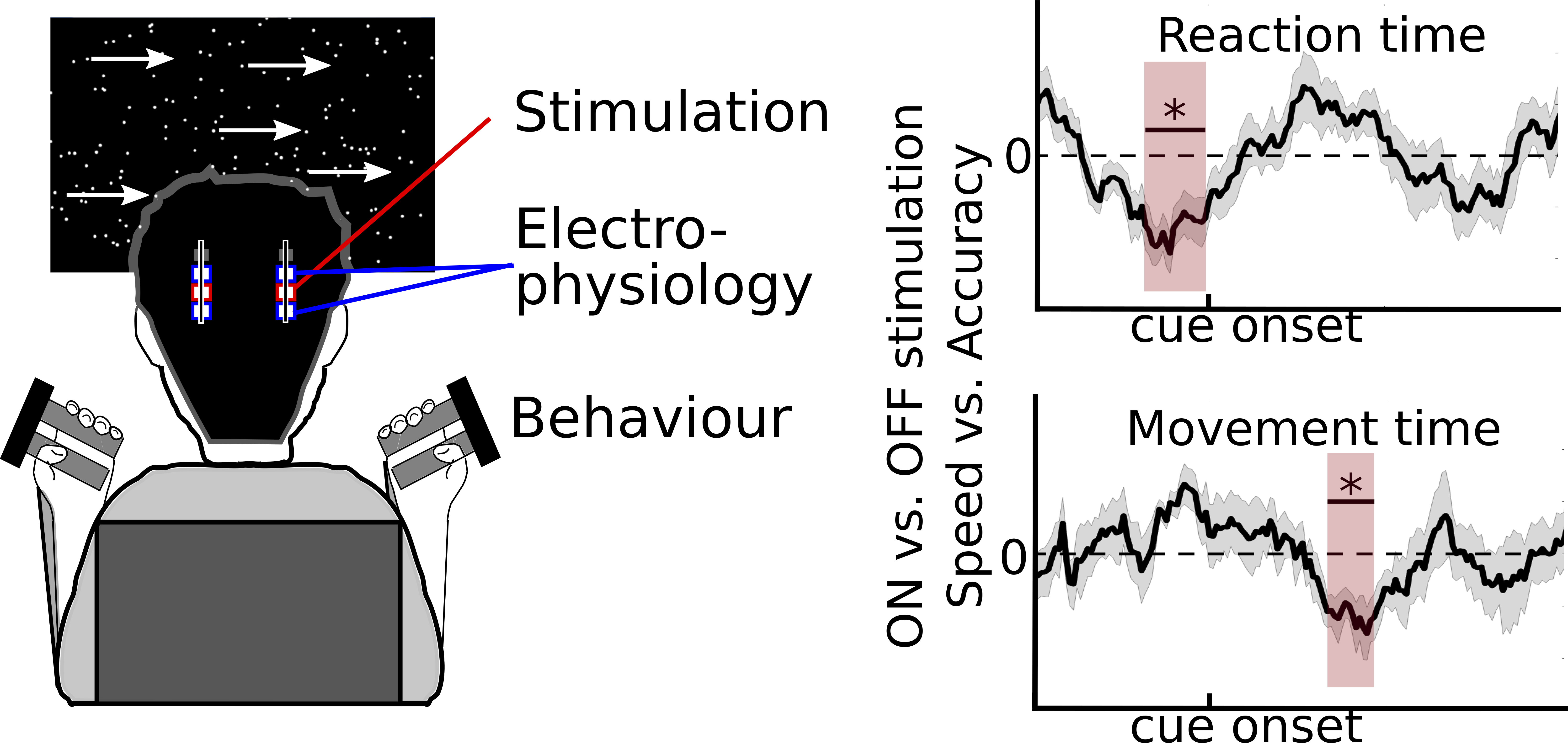
People often have to adjust the speed at which they think and act, for example when faced with difficult choices or time pressure. Here, we studied whether and how a brain area called the subthalamic nucleus contributes to this. We discovered that the human subthalamic nucleus can separately control the speed of decisions and movement, and that this control can work independently on each side of the body.

Scientific Abstract

To optimally adjust our behavior to changing environments we need to both adjust the speed of our decisions and movements. Yet little is known about the extent to which these processes are controlled by common or separate mechanisms. Furthermore, while previous evidence from computational models and empirical studies suggests that the basal ganglia play an important role during adjustments of decision-making, it remains unclear how this is implemented. Leveraging the opportunity to directly access the subthalamic nucleus of the basal ganglia in humans undergoing deep brain stimulation surgery, we here combine invasive electrophysiological recordings, electrical stimulation and computational modelling of perceptual decision-making. We demonstrate that, while similarities between subthalamic control of decision- and movement speed exist, the causal contribution of the subthalamic nucleus to these processes can be disentangled. Our results show that the basal ganglia independently control the speed of decisions and movement for each hemisphere during adaptive behavior.

Similar content

Preprint
Liebana Garcia S, Laffere A, Toschi C, Schilling L, Podlaski J, Fritsche M, Zatka-Haas P, Li Y, Bogacz R, Saxe A, Lak A

Striatal dopamine reflects individual long-term learning trajectories

Preprint
Pinchetti L, Qi C, Lokshyn O, Oliviers G, Emde C, Tang M, M'Charrak A, Frieder S, Menzat B, Bogacz R, Lukasiewicz T, Salvatori T

Benchmarking Predictive Coding Networks -- Made Simple

Dynamic control of decision and movement speed in the human basal ganglia.

Bange M
Gonzalez-Escamilla G
Auer M
Ashkan K
Muthuraman M
Groppa S

People often have to adjust the speed at which they think and act, for example when faced with difficult choices or time pressure. Here, we studied whether and how a brain area called the subthalamic nucleus contributes to this. We discovered that the human subthalamic nucleus can separately control the speed of decisions and movement, and that this control can work independently on each side of the body.

Scientific Abstract

To optimally adjust our behavior to changing environments we need to both adjust the speed of our decisions and movements. Yet little is known about the extent to which these processes are controlled by common or separate mechanisms. Furthermore, while previous evidence from computational models and empirical studies suggests that the basal ganglia play an important role during adjustments of decision-making, it remains unclear how this is implemented. Leveraging the opportunity to directly access the subthalamic nucleus of the basal ganglia in humans undergoing deep brain stimulation surgery, we here combine invasive electrophysiological recordings, electrical stimulation and computational modelling of perceptual decision-making. We demonstrate that, while similarities between subthalamic control of decision- and movement speed exist, the causal contribution of the subthalamic nucleus to these processes can be disentangled. Our results show that the basal ganglia independently control the speed of decisions and movement for each hemisphere during adaptive behavior.

Citation

2022. Nat Commun, 13(1):7530.

DOI

10.1038/s41467-022-35121-8

Free Full Text at Europe PMC

PMC9729212

Similar content

Preprint
Liebana Garcia S, Laffere A, Toschi C, Schilling L, Podlaski J, Fritsche M, Zatka-Haas P, Li Y, Bogacz R, Saxe A, Lak A

Striatal dopamine reflects individual long-term learning trajectories

Preprint
Pinchetti L, Qi C, Lokshyn O, Oliviers G, Emde C, Tang M, M'Charrak A, Frieder S, Menzat B, Bogacz R, Lukasiewicz T, Salvatori T

Benchmarking Predictive Coding Networks -- Made Simple