Dendritic Integration of Sensory Evidence in Perceptual Decision-Making.

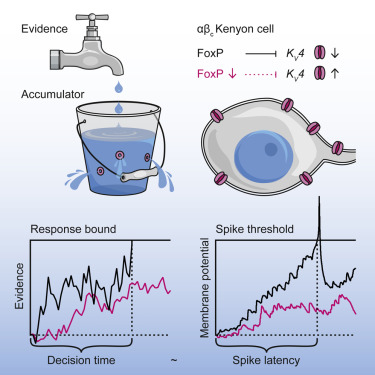
As we make decisions between alternative options, our brains accumulate evidence for one option over another. Exactly how this process of evidence accumulation is represented in nerve cell activity is unclear. Here, we collaborated with scientists working on fruit fly brains to shed new light on the ways that specialised nerve cells assimilate information from other cells to guide decision making.
Scientific Abstract
Perceptual decisions require the accumulation of sensory information to a response criterion. Most accounts of how the brain performs this process of temporal integration have focused on evolving patterns of spiking activity. We report that subthreshold changes in membrane voltage can represent accumulating evidence before a choice. αβ core Kenyon cells (αβ KCs) in the mushroom bodies of fruit flies integrate odor-evoked synaptic inputs to action potential threshold at timescales matching the speed of olfactory discrimination. The forkhead box P transcription factor (FoxP) sets neuronal integration and behavioral decision times by controlling the abundance of the voltage-gated potassium channel Shal (K4) in αβ KC dendrites. αβ KCs thus tailor, through a particular constellation of biophysical properties, the generic process of synaptic integration to the demands of sequential sampling.
Similar content
ePC: Fast and Deep Predictive Coding in Digital Simulation
ePC: Fast and Deep Predictive Coding in Digital Simulation
On the Infinite Width and Depth Limits of Predictive Coding Networks
Temporally distinct reward and action prediction error signals during value learning and habit formation
Dendritic Integration of Sensory Evidence in Perceptual Decision-Making.
As we make decisions between alternative options, our brains accumulate evidence for one option over another. Exactly how this process of evidence accumulation is represented in nerve cell activity is unclear. Here, we collaborated with scientists working on fruit fly brains to shed new light on the ways that specialised nerve cells assimilate information from other cells to guide decision making.
Scientific Abstract
Perceptual decisions require the accumulation of sensory information to a response criterion. Most accounts of how the brain performs this process of temporal integration have focused on evolving patterns of spiking activity. We report that subthreshold changes in membrane voltage can represent accumulating evidence before a choice. αβ core Kenyon cells (αβ KCs) in the mushroom bodies of fruit flies integrate odor-evoked synaptic inputs to action potential threshold at timescales matching the speed of olfactory discrimination. The forkhead box P transcription factor (FoxP) sets neuronal integration and behavioral decision times by controlling the abundance of the voltage-gated potassium channel Shal (K4) in αβ KC dendrites. αβ KCs thus tailor, through a particular constellation of biophysical properties, the generic process of synaptic integration to the demands of sequential sampling.
Citation
Free Full Text at Europe PMC
PMC5947940Downloads