The Cognitive Role of the Globus Pallidus interna; Insights from Disease States.

We recorded the electrical activity of nerve cells lying deep in the brain of people affected by movement disorders, and studied how this activity changes during a learning task. We observed that the nerve cell activity that occurred after receiving sensory information is altered in Parkinson's disease.
Scientific Abstract
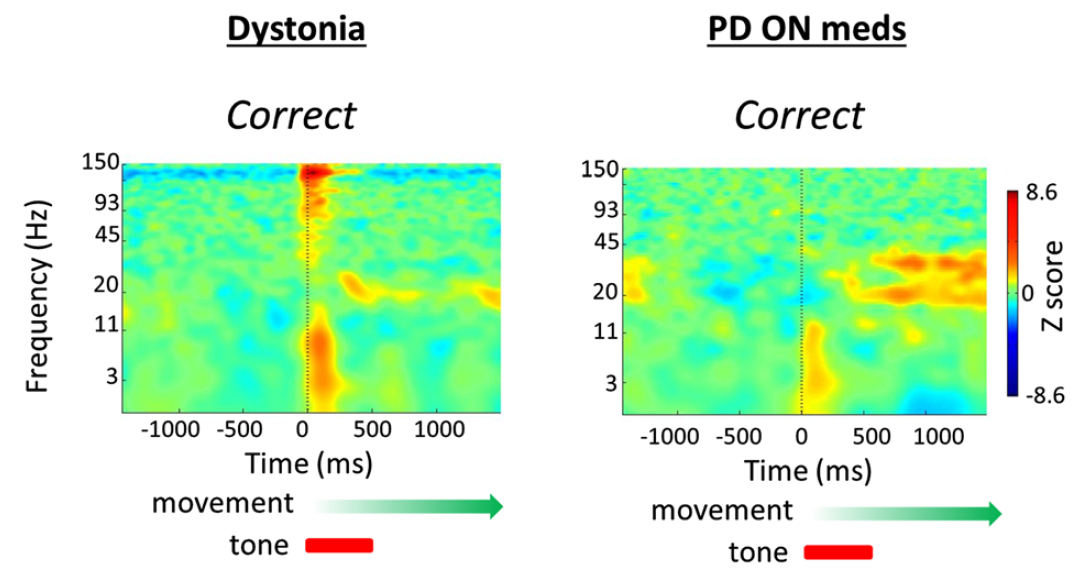
The motor symptoms of both Parkinson's disease and focal dystonia arise from dysfunction of the basal ganglia, and are improved by pallidotomy or deep brain stimulation of the Globus Pallidus interna (GPi). However, Parkinson's disease is associated with a greater degree of basal ganglia-dependent learning impairment than dystonia. We attempt to understand this observation in terms of a comparison of the electrophysiology of the output of the basal ganglia between the two conditions. We use the natural experiment offered by Deep Brain Stimulation to compare GPi local field potential responses in subjects with Parkinson's disease compared to subjects with dystonia performing a forced-choice decision-making task with sensory feedback. In dystonic subjects, we found that auditory feedback was associated with the presence of high gamma oscillations nestled on a negative deflection, morphologically similar to sharp wave ripple complexes described in human rhinal cortex. These were not present in Parkinson's disease subjects. The temporal properties of the high gamma burst were modified by incorrect trial performance compared to correct trial performance. Both groups exhibited a robust low frequency response to 'incorrect' trial performance in dominant GPi but not non-dominant GPi at theta frequency. Our results suggest that cellular processes associated with striatum-dependent memory function may be selectively impaired in Parkinson's disease even if dopaminergic drugs are administered, but that error detection mechanisms are preserved.
Similar content
Preprint
MRC CoRE in RND Output
ePC: Fast and Deep Predictive Coding in Digital Simulation
Paper
MRC CoRE in RND Output
ePC: Fast and Deep Predictive Coding in Digital Simulation
2026. 43rd International Conference on Machine Learning
Paper
MRC CoRE in RND Output
On the Infinite Width and Depth Limits of Predictive Coding Networks
2026, Proceedings of the 43rd International Conference on Machine Learning
Preprint
MRC CoRE in RND Output
Temporally distinct reward and action prediction error signals during value learning and habit formation
The Cognitive Role of the Globus Pallidus interna; Insights from Disease States.
We recorded the electrical activity of nerve cells lying deep in the brain of people affected by movement disorders, and studied how this activity changes during a learning task. We observed that the nerve cell activity that occurred after receiving sensory information is altered in Parkinson's disease.
Scientific Abstract
The motor symptoms of both Parkinson's disease and focal dystonia arise from dysfunction of the basal ganglia, and are improved by pallidotomy or deep brain stimulation of the Globus Pallidus interna (GPi). However, Parkinson's disease is associated with a greater degree of basal ganglia-dependent learning impairment than dystonia. We attempt to understand this observation in terms of a comparison of the electrophysiology of the output of the basal ganglia between the two conditions. We use the natural experiment offered by Deep Brain Stimulation to compare GPi local field potential responses in subjects with Parkinson's disease compared to subjects with dystonia performing a forced-choice decision-making task with sensory feedback. In dystonic subjects, we found that auditory feedback was associated with the presence of high gamma oscillations nestled on a negative deflection, morphologically similar to sharp wave ripple complexes described in human rhinal cortex. These were not present in Parkinson's disease subjects. The temporal properties of the high gamma burst were modified by incorrect trial performance compared to correct trial performance. Both groups exhibited a robust low frequency response to 'incorrect' trial performance in dominant GPi but not non-dominant GPi at theta frequency. Our results suggest that cellular processes associated with striatum-dependent memory function may be selectively impaired in Parkinson's disease even if dopaminergic drugs are administered, but that error detection mechanisms are preserved.
Citation
2017.Exp Brain Res, 235(5):1455-1465.
Free Full Text at Europe PMC
PMC5380693Downloads
Similar content
Preprint
MRC CoRE in RND Output
ePC: Fast and Deep Predictive Coding in Digital Simulation
Paper
MRC CoRE in RND Output
ePC: Fast and Deep Predictive Coding in Digital Simulation
2026. 43rd International Conference on Machine Learning
Paper
MRC CoRE in RND Output
On the Infinite Width and Depth Limits of Predictive Coding Networks
2026, Proceedings of the 43rd International Conference on Machine Learning
Preprint
MRC CoRE in RND Output