The highs and lows of beta activity in cortico-basal ganglia loops.

Scientific Abstract
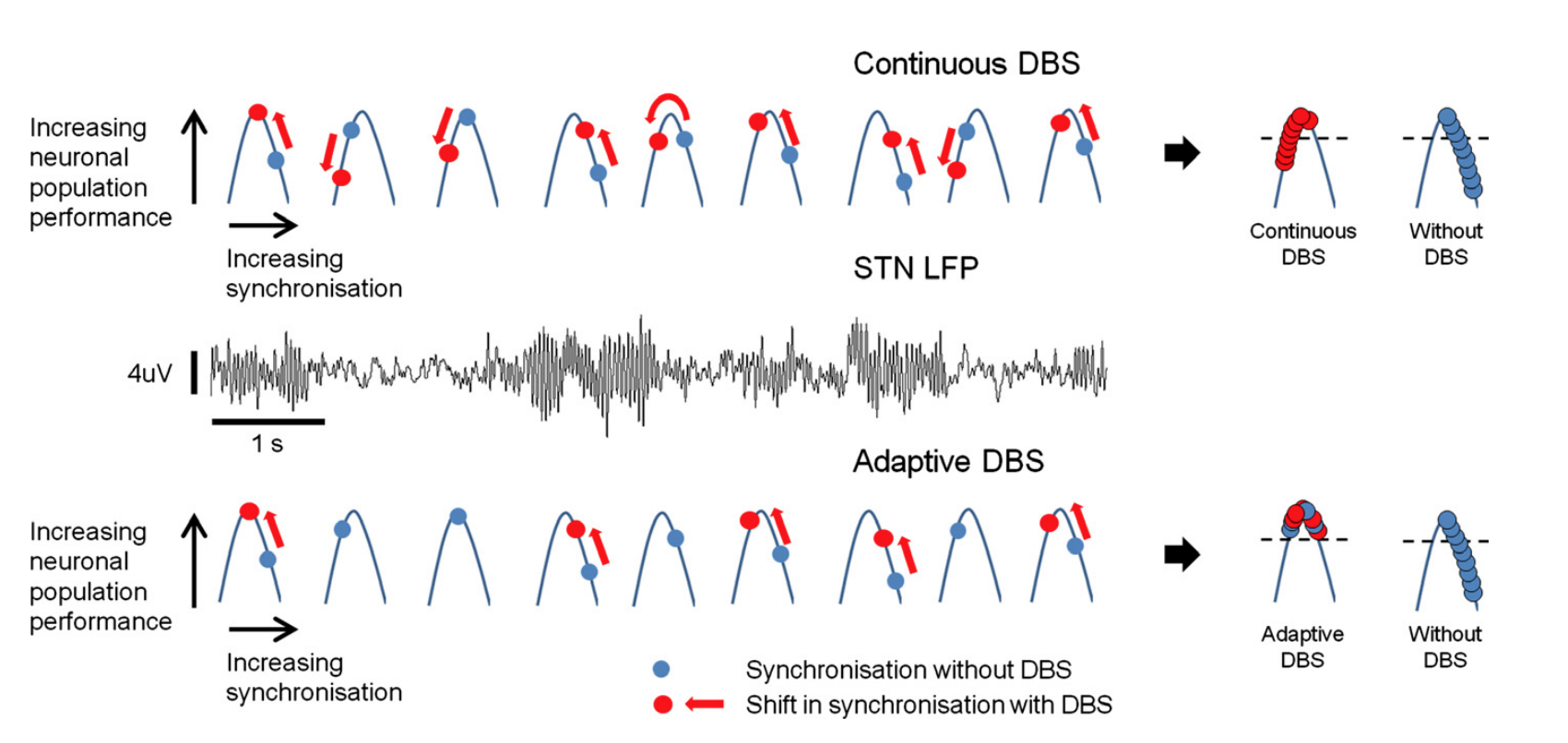
Oscillatory activity in the beta (13-30 Hz) frequency band is widespread in cortico-basal ganglia circuits, and becomes prominent in Parkinson's disease (PD). Here we develop the hypothesis that the degree of synchronization in this frequency band is a critical factor in gating computation across a population of neurons, with increases in beta band synchrony entailing a loss of information-coding space and hence computational capacity. Task and context drive this dynamic gating, so that for each state there will be an optimal level of network synchrony, and levels lower or higher than this will impair behavioural performance. Thus, both the pathological exaggeration of synchrony, as observed in PD, and the ability of interventions like deep brain stimulation (DBS) to excessively suppress synchrony can potentially lead to impairments in behavioural performance. Indeed, under physiological conditions, the manipulation of computational capacity by beta activity may itself present a mechanism of action selection and maintenance.
Similar content
Preprint
MRC CoRE in RND Output
Distinct In Vivo Electrophysiological Profiles of Mediodorsal Thalamus Subdivisions
Paper
MRC CoRE in RND Output
Modulation of motor cortical theta and gamma oscillations using phase-targeted, closed-loop optogenetic stimulation of local excitatory and inhibitory neurons.
2026. Brain Stimul, 19(2):103034.
Preprint
A clinical grade neurostimulation implant for hierarchical control of physiological activity
Paper
Cortical signatures of sleep are altered following effective deep brain stimulation for depression
2024. Translational Psychiatry, 14(1), 103.
The highs and lows of beta activity in cortico-basal ganglia loops.
Scientific Abstract
Oscillatory activity in the beta (13-30 Hz) frequency band is widespread in cortico-basal ganglia circuits, and becomes prominent in Parkinson's disease (PD). Here we develop the hypothesis that the degree of synchronization in this frequency band is a critical factor in gating computation across a population of neurons, with increases in beta band synchrony entailing a loss of information-coding space and hence computational capacity. Task and context drive this dynamic gating, so that for each state there will be an optimal level of network synchrony, and levels lower or higher than this will impair behavioural performance. Thus, both the pathological exaggeration of synchrony, as observed in PD, and the ability of interventions like deep brain stimulation (DBS) to excessively suppress synchrony can potentially lead to impairments in behavioural performance. Indeed, under physiological conditions, the manipulation of computational capacity by beta activity may itself present a mechanism of action selection and maintenance.
Citation
2014.Eur. J. Neurosci., 39(11):1951-9.
Free Full Text at Europe PMC
PMC4285950Downloads
Similar content
Preprint
MRC CoRE in RND Output
Distinct In Vivo Electrophysiological Profiles of Mediodorsal Thalamus Subdivisions
Paper
MRC CoRE in RND Output
Modulation of motor cortical theta and gamma oscillations using phase-targeted, closed-loop optogenetic stimulation of local excitatory and inhibitory neurons.
2026. Brain Stimul, 19(2):103034.
Preprint
A clinical grade neurostimulation implant for hierarchical control of physiological activity
Paper
Cortical signatures of sleep are altered following effective deep brain stimulation for depression
2024. Translational Psychiatry, 14(1), 103.